14 Japanese Living Room Ideas for Serene Spaces
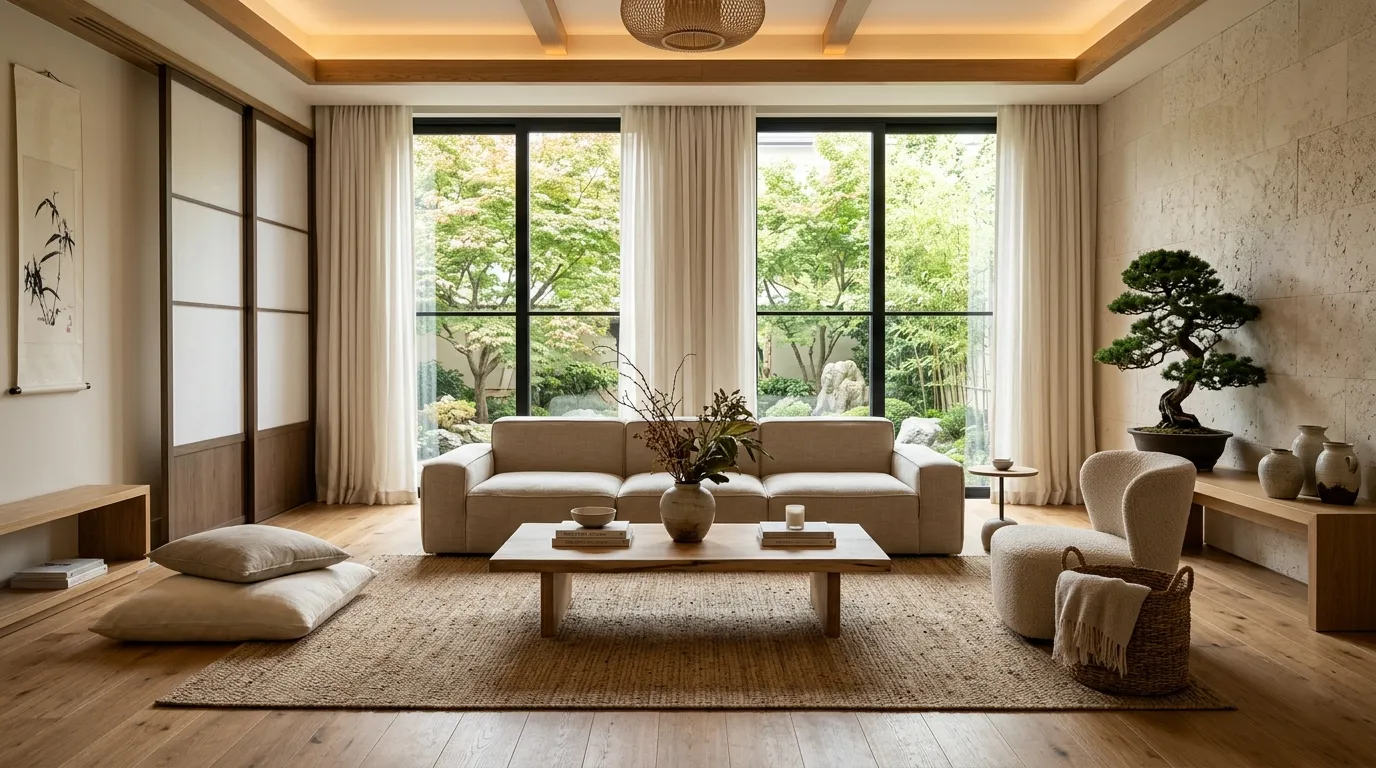
Japanese interior design is built on a set of ideas about space, material, and beauty that are genuinely different from those that underpin most Western design traditions, and understanding those ideas even at a basic level changes the way you think about a living room and what it is for. The Japanese concept of ma, the meaningful quality of empty space, suggests that what is absent from a room contributes as much to its character as what is present. The concept of wabi sabi, the beauty found in imperfection, impermanence, and natural materials as they age and change, suggests that a room should embrace rather than conceal the evidence of time and use. The concept of shizen, naturalness, suggests that the materials and forms in a living space should feel connected to the natural world rather than opposed to it. These ideas together produce interiors of extraordinary calm and extraordinary beauty, and they translate into practical design decisions that any living room can benefit from regardless of its location or its cultural context.
The fourteen ideas here are not a recipe for a Japanese themed room in the superficial sense of placing shoji screens and bonsai trees in a space that is otherwise unchanged. They are an invitation to apply Japanese design principles in ways that genuinely transform how a living room feels and how it functions as a space to inhabit. The difference between a Japanese inspired living room and a Japanese themed one is the difference between understanding the principles and simply borrowing the aesthetics, and the ideas that follow are firmly on the side of genuine understanding.
1. Embrace the Principle of Ma
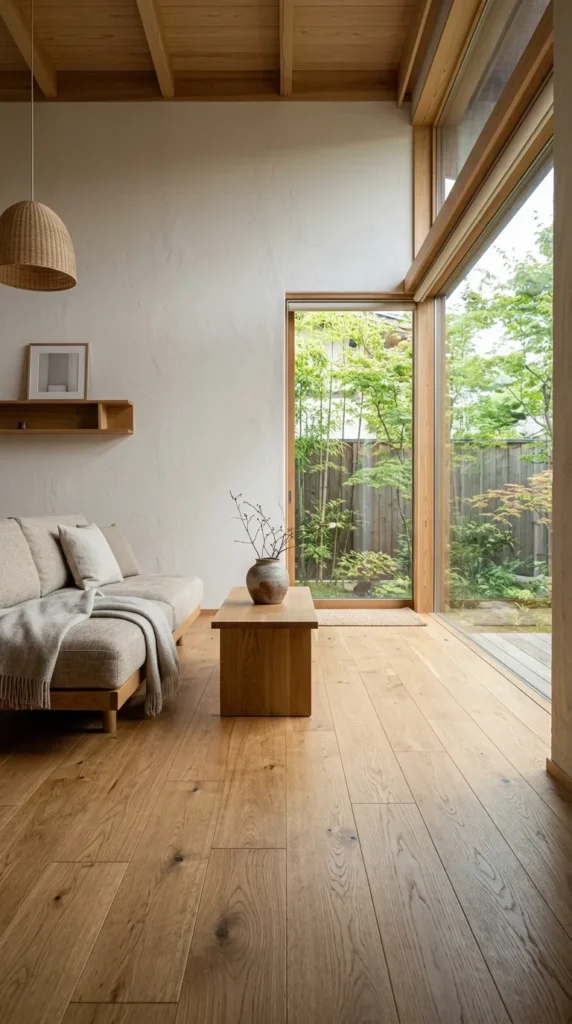
Ma is perhaps the most fundamental and most practically useful concept in Japanese design for anyone trying to create a more beautiful and more calming living room. It describes the quality of intentional empty space, the pause between things, the breathing room that allows each element in a composition to be perceived clearly and to have its full effect rather than competing with neighboring elements for attention. In a living room, ma means resisting the impulse to fill every surface, to use every corner, to justify every centimeter of wall space with furniture or decoration. It means treating empty space as a positive design choice rather than a failure to complete the room.
Applying the principle of ma in a practical way begins with a clear assessment of what is currently in the living room and whether each element genuinely earns its presence. Remove anything that is present out of habit rather than genuine affection or genuine function. Move furniture away from the walls to create space around it rather than filling the perimeter of the room with a ring of furniture that leaves only the center empty. Leave surfaces clear except for one or two objects chosen with genuine intention. Allow wall space to remain undecorated rather than filling it with art and mirrors and shelving simply because it is there. The room that results from this kind of disciplined subtraction will feel larger, calmer, and more resolved than the room that preceded it, and the objects that remain will have a presence and a visibility that they lacked when surrounded by competition.
2. Choose Natural Materials Throughout
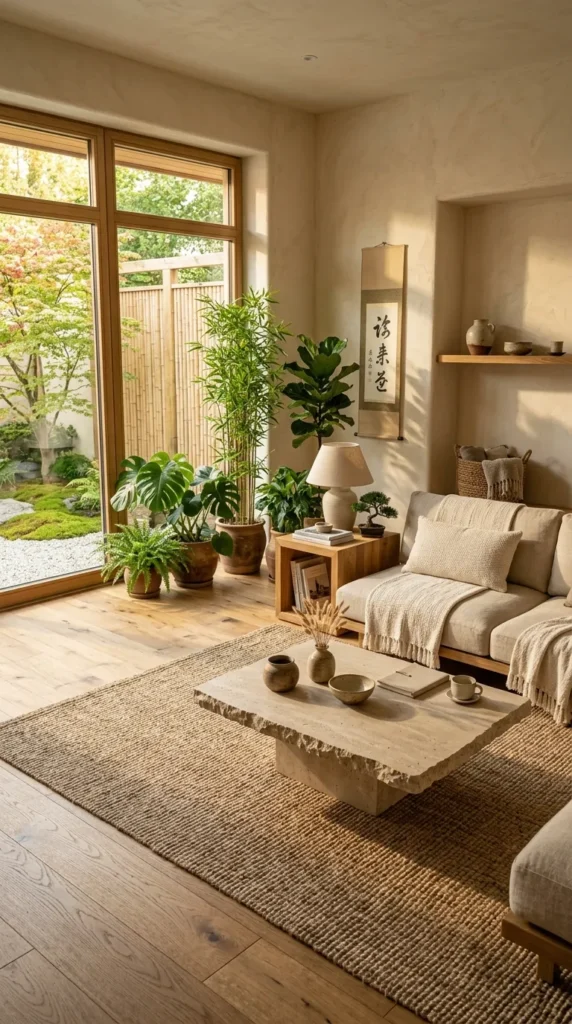
The connection to natural materials is fundamental to Japanese design in a way that goes beyond aesthetic preference into something closer to a philosophical conviction that human beings live better and feel better when the materials surrounding them come from the natural world rather than from industrial processes. Timber, stone, paper, clay, linen, cotton, bamboo, rattan, these are the materials that define the Japanese interior and that create its characteristic quality of organic warmth and material honesty. Synthetic materials, however convincing their imitation of natural surfaces, lack the variation, the tactile quality, and the aging characteristics that make natural materials genuinely beautiful over time.
In a living room, the commitment to natural materials means choosing timber flooring over vinyl or laminate, natural fiber rugs over synthetic ones, linen or cotton upholstery over polyester, clay or stone vessels over plastic or resin, timber furniture over MDF or particleboard construction. None of these choices requires an enormous budget. Simple timber furniture from sustainable sources, a jute or wool rug, linen cushion covers, a few ceramic vessels in simple glazes, all of these are accessible at a wide range of price points and together create a living room whose material character is genuinely honest and genuinely warm in a way that synthetic alternatives cannot replicate regardless of their technical sophistication.
3. Keep the Color Palette Grounded in Nature
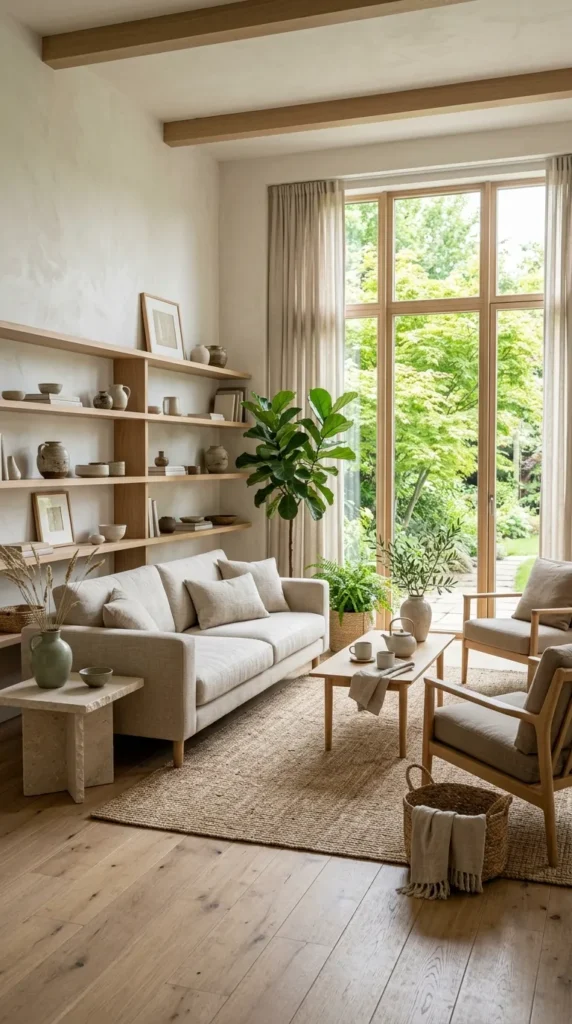
The color palette of Japanese interiors is drawn directly from the natural world, and it tends toward the quiet, the earthy, and the subtly varied rather than the bold, the saturated, and the high contrast. The colors of Japanese design are the colors of unpainted timber, of natural stone, of undyed linen, of moss and lichen, of the bark of trees and the surface of still water. They are not the vibrant colors of the Japanese decorative arts tradition, which is a different and equally extraordinary visual language. The colors of Japanese living spaces are calm, grounded, and deeply connected to the materials from which they come rather than applied as decoration over a neutral surface.
In practical terms, this palette means walls in warm white, pale clay, soft stone grey, or the very lightest sage green. Floors in natural timber or pale stone. Upholstery in undyed linen, natural cotton, or wool in its natural tones. Rugs in jute, seagrass, or wool in warm neutrals. Accessories in the natural colors of clay, unglazed ceramic, aged timber, and stone. The overall effect is one of extreme tonal harmony, a room where everything relates to everything else through shared connection to natural material color rather than through deliberately coordinated color choices. This harmony creates the quality of visual calm that Japanese interiors are celebrated for and that is very difficult to achieve through any other approach to color.
4. Bring the Floor Into the Living Space
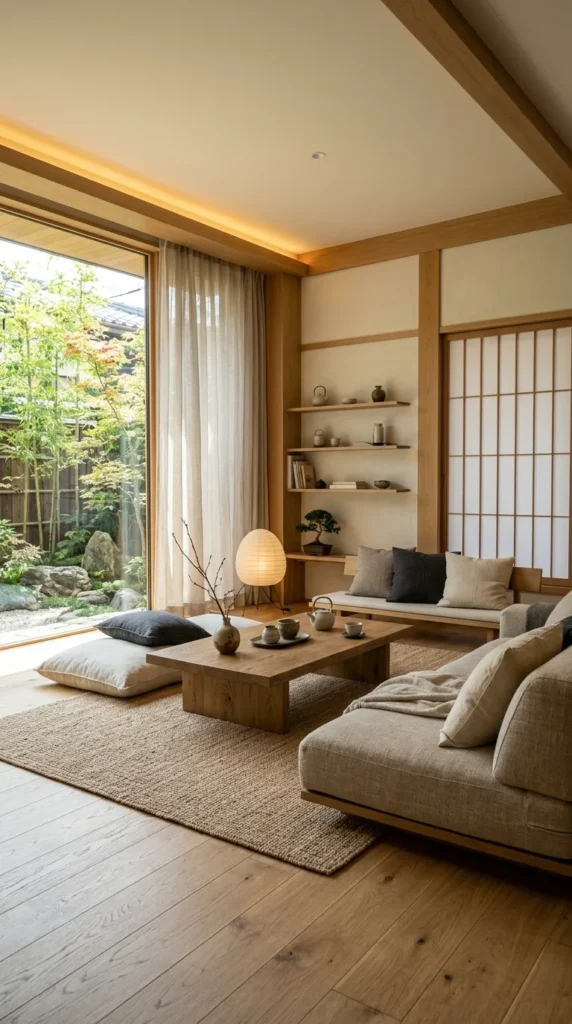
In traditional Japanese domestic life, the floor is a primary living surface rather than simply a surface to walk across, and this relationship to the floor creates an entirely different quality of inhabitation in a room. Low furniture, cushions for seating rather than raised chairs, futons that are laid out and put away rather than permanent beds and sofas, all of these reflect a domestic culture that is genuinely comfortable at floor level in a way that most Western homes are not. In a contemporary living room, bringing some of this floor level orientation into the space creates a quality of groundedness and ease that higher furniture arrangements do not provide.
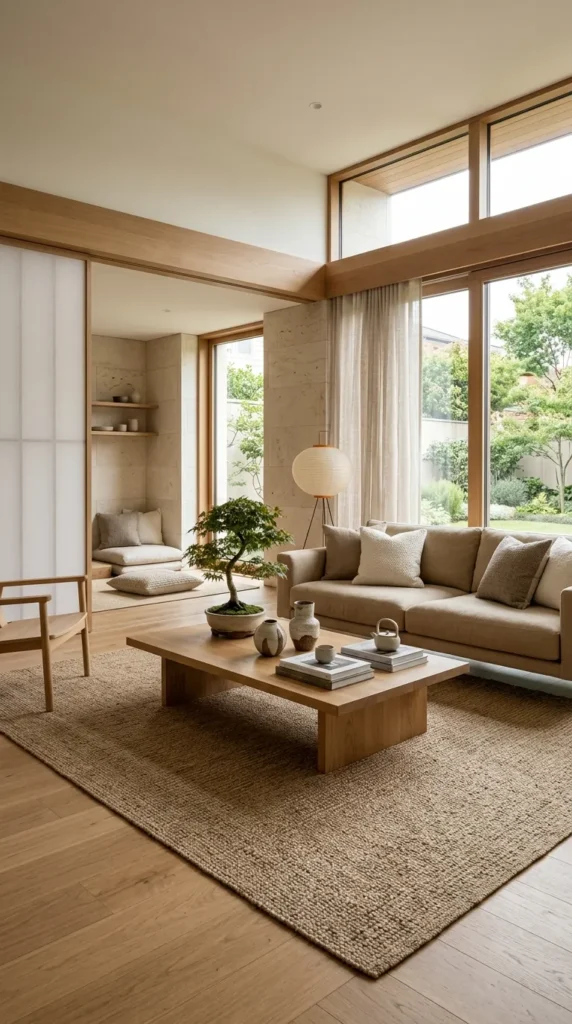
The most accessible version of this idea in a contemporary living room is to lower the overall profile of the furniture, choosing sofas and chairs with lower seat heights and lower backs than standard Western furniture, and to supplement the seating with large floor cushions or zabuton in natural linen or cotton that can be used for informal seating directly on the floor. A low coffee table at the correct height for floor or low seating, approximately thirty to forty centimeters, anchors the seating arrangement and reinforces the horizontal emphasis that is so characteristic of Japanese interior design. A large, beautiful rug in a natural fiber creates the soft floor surface that makes floor level use genuinely comfortable and inviting rather than simply possible.
Love calm, clutter-free spaces? Explore 14 Apartment Living Room Ideas for smart layouts that maximize comfort in smaller homes.
5. Use Shoji Screens as Room Dividers
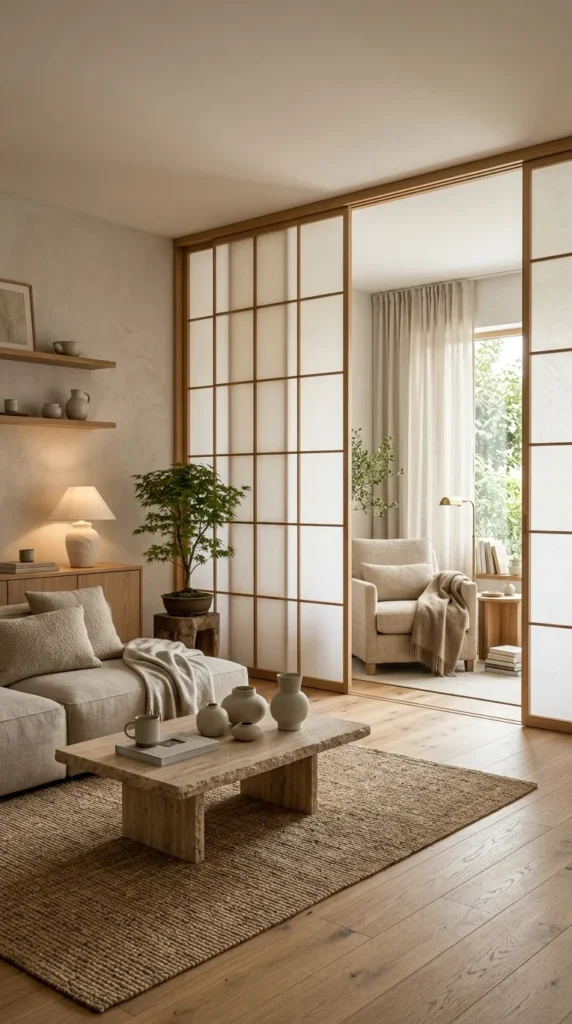
Shoji screens, the lightweight sliding panels of timber and translucent paper that are one of the most recognizable elements of traditional Japanese architecture, create in a living room a quality of filtered, diffused light and flexible space division that no other single element can replicate. The paper panels allow light to pass through them while obscuring the view beyond, creating a luminous glow in the room that changes in quality as the light outside changes throughout the day. The sliding mechanism allows the screens to be moved to create or dissolve the boundary between spaces as circumstances require, which is the fundamental spatial principle of Japanese domestic architecture.
In a contemporary Western living room, shoji screens work most effectively as a way of managing light quality, screening off a portion of the room for privacy, or creating a beautiful backdrop behind the seating area. A series of shoji panels positioned on a track along one wall of the living room creates a backdrop of warm, translucent light that transforms the quality of the entire room when backlit by natural light or by artificial light placed behind the panels. Contemporary shoji screens are available from specialist suppliers and from some mainstream furniture retailers, and they can be freestanding, wall mounted, or fitted to ceiling tracks depending on the specific application and the degree of permanence required.
6. Choose One Statement Piece of Craft
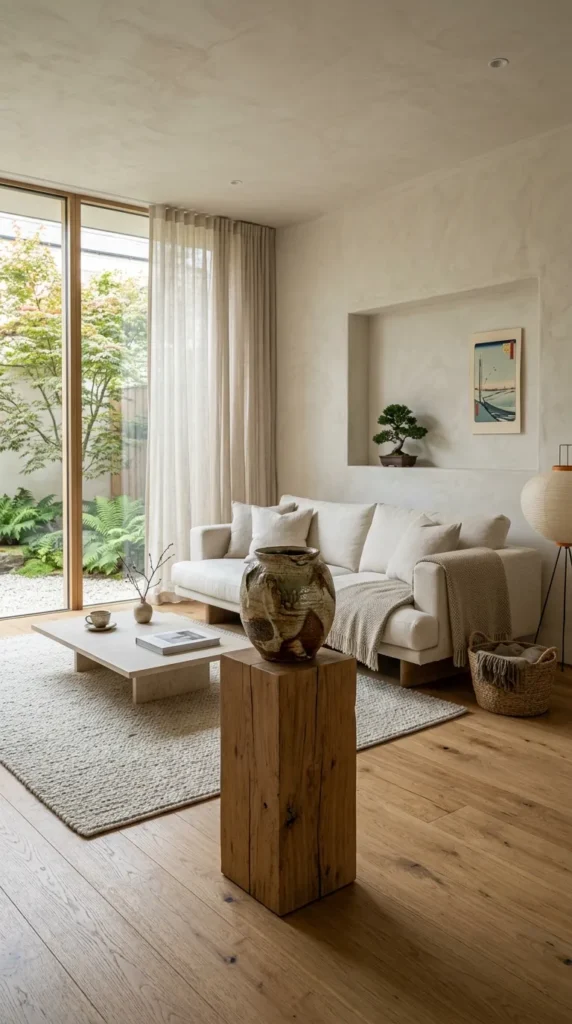
Japanese design places enormous value on the individual craft object, the single piece made by a skilled maker whose knowledge and care are visible in every detail of the finished work. In a Japanese living room, one beautifully made ceramic vessel, one piece of lacquerware, one hand forged iron object, one length of hand dyed textile, contributes more to the character and the quality of the space than a room full of mass produced decorative objects combined. The single craft object is given space to be seen and appreciated, positioned with genuine attention to its relationship to the surrounding elements, and allowed to represent the value that Japanese design places on human skill and material knowledge.
Choosing a statement craft object for a living room is an invitation to look carefully and to invest in something genuinely made rather than simply manufactured. A ceramic bowl or vessel from a working studio potter whose process and material knowledge you understand and appreciate. A piece of furniture made by a joiner whose craft is visible in the joinery details and the surface finish. A textile whose dyeing or weaving process has created a surface of genuine complexity and beauty. These objects are not necessarily expensive, but they are chosen with a different quality of attention than most domestic objects receive, and this quality of attention is what Japanese design asks of the people who live within it.
7. Incorporate Bamboo Elements
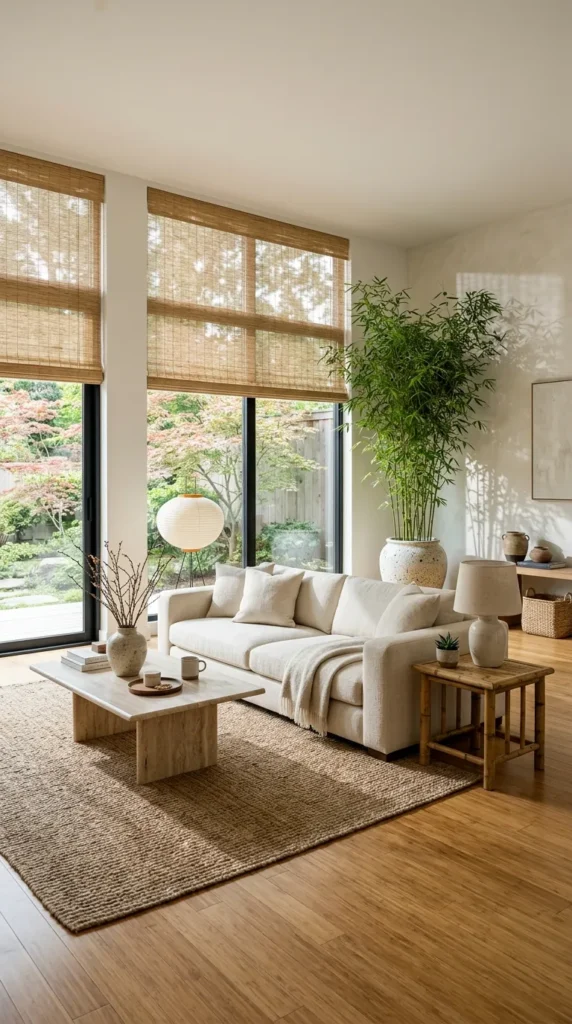
Bamboo is one of the most beautiful and most versatile natural materials available for interior use, and its association with Japanese design and Japanese landscape makes it one of the most effective material choices for a living room that wants to reference that tradition genuinely rather than superficially. Bamboo flooring, with its distinctive grain pattern and its warm honey tone, creates a floor of considerable beauty and excellent durability. Bamboo furniture, particularly chairs and side tables in bent bamboo construction, creates a lightweight, organic quality that timber furniture of equivalent function cannot quite replicate. Bamboo blinds filter natural light with a quality of warm, organic diffusion that creates a distinctly Japanese quality of interior atmosphere.
A living bamboo plant, a tall clumping bamboo variety in a large ceramic container, brings the material into the room in its living form and creates a presence of genuine natural drama. The vertical line of bamboo canes, the rustling movement of the leaves in air currents from an open window or a ventilation system, the way light falls through the leaves and creates shifting shadows on the wall behind, all of these qualities make living bamboo one of the most beautiful and most characterful plant choices available for a Japanese inspired living room. Choose a clumping rather than a running variety to keep the plant contained within its pot without aggressive root spread.
8. Display Ikebana or Simple Flower Arrangements
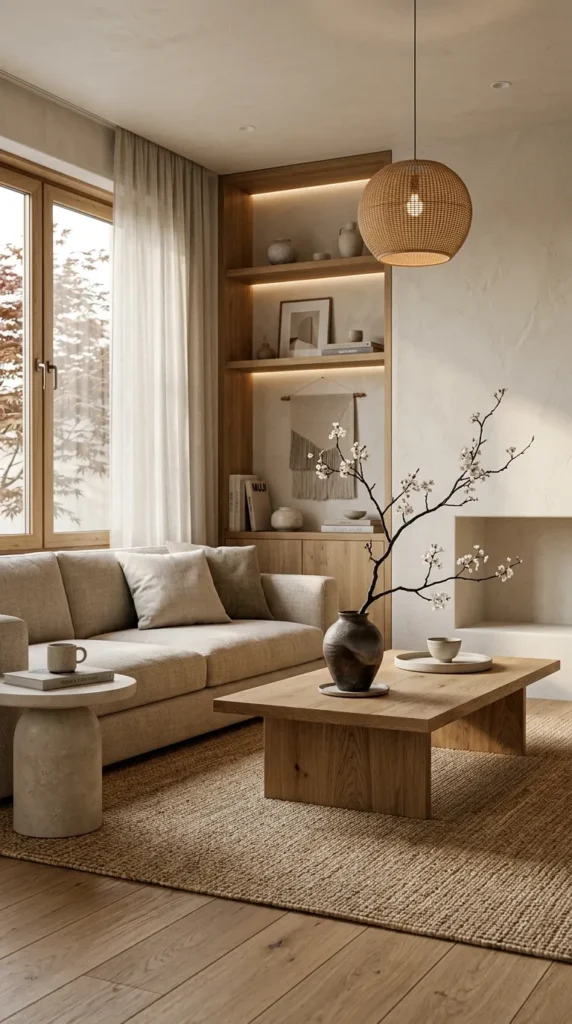
Ikebana, the Japanese art of flower arranging, is the design philosophy that most completely captures the Japanese approach to natural beauty in domestic space. Where Western flower arranging tends toward abundance, symmetry, and the visual impact of many flowers combined, ikebana works with very few elements, often just two or three stems, arranged in asymmetric compositions that emphasize the natural form of each element, the line of a stem, the angle of a branch, the curve of a leaf, rather than the collective impression of many elements together. The result is arrangements of extraordinary restraint and extraordinary presence that use empty space as actively as they use the plant material itself.
You do not need to study ikebana formally to bring this sensibility into a living room, though formal study would certainly deepen your understanding and your skill. Simply begin with fewer elements than you instinctively reach for when arranging flowers or branches, place them in a vessel whose form is beautiful in its own right, and consider the relationship between the plant material and the empty space around it as carefully as you consider the plant material itself. A single branch of flowering cherry in a simple ceramic vessel. Three stems of dried grass in a tall cylindrical vase. A single large leaf in a low wide bowl. Any of these simple compositions, placed with attention to its position in the room and its relationship to the light source nearest to it, creates a focal point of genuine Japanese inspired beauty.
9. Use Tatami Inspired Flooring
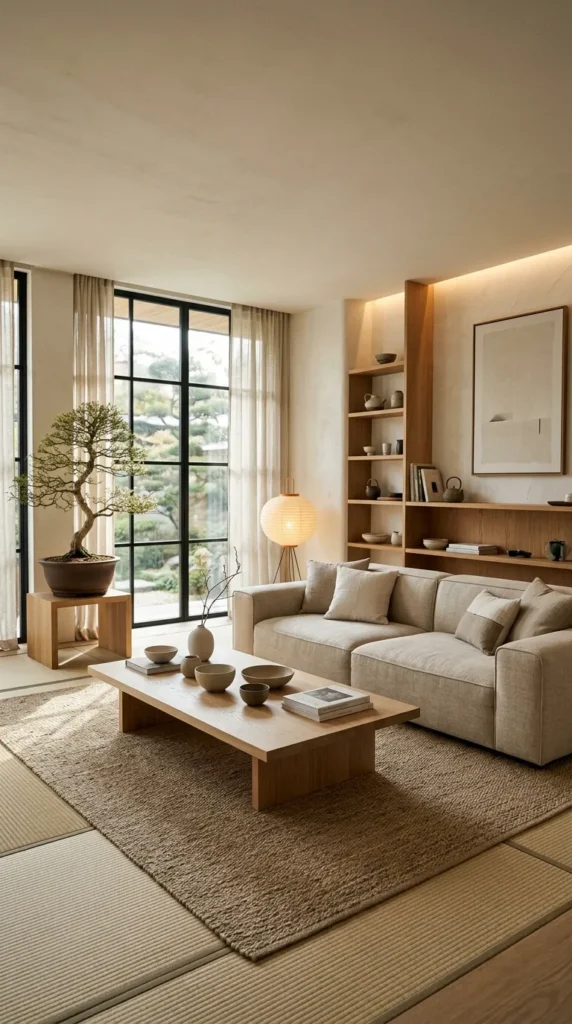
Tatami, the thick woven rush mat that has been the primary flooring material of traditional Japanese domestic spaces for centuries, creates a floor surface of extraordinary warmth, acoustic softness, and visual calm. Its regular grid of woven rushes creates a pattern of quiet geometric interest at floor level, its texture is warm and slightly yielding underfoot, and its natural color, a warm green that fades over time to a warm golden honey, creates a floor surface that ages beautifully and becomes more beautiful with use rather than showing wear in ways that diminish its appeal.
Genuine tatami is not widely available outside Japan and requires specific subfloor construction and ongoing maintenance that makes it impractical for most living rooms outside of Japanese cultural contexts. But the tatami aesthetic can be referenced and approximated in several ways. A large woven seagrass or rush rug in a warm honey tone creates a very similar surface quality and visual character at a fraction of the complexity of genuine tatami installation. Woven bamboo mats in a tatami format are available from specialist suppliers and create an authentic material reference. Natural fiber flooring in jute, seagrass, or sisal installed wall to wall creates the closest equivalent to the tatami room in terms of the overall quality of warmth and material authenticity it creates throughout the space.
10. Minimize Window Treatments
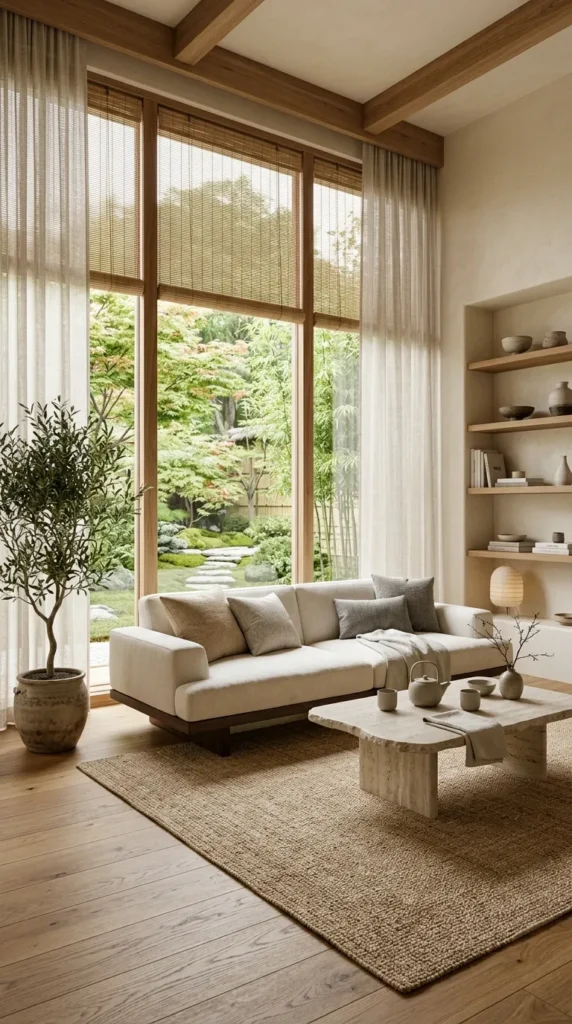
Japanese architecture has a fundamentally different relationship to the boundary between interior and exterior space than most Western building traditions, one that treats the boundary as permeable and transitional rather than definitive and sealed. Windows in traditional Japanese architecture are not simply openings in a wall but mediating elements between the interior domestic world and the natural world beyond, and the way they are treated reflects this understanding. Heavy curtains that completely seal the interior from the exterior are antithetical to this sensibility. Simple, lightweight treatments that allow the boundary to remain present while moderating light and temperature are much more aligned with the Japanese approach.
In a contemporary living room, minimizing window treatment means choosing the simplest and lightest options that provide the practical privacy and light control the room requires. Sheer linen panels that filter rather than block natural light and that move visibly in any air movement, creating a quality of animated, living boundary between interior and exterior. Simple roller blinds in a natural material that can be pulled fully clear of the window opening during daylight hours and rolled down only when privacy is required. Bamboo blinds whose filtered light quality creates the warm, diffused illumination that is so characteristic of Japanese interior atmosphere. Any of these approaches maintains the connection between the interior and the natural world outside that Japanese design values so highly.
11. Create a Tokonoma Inspired Focal Point
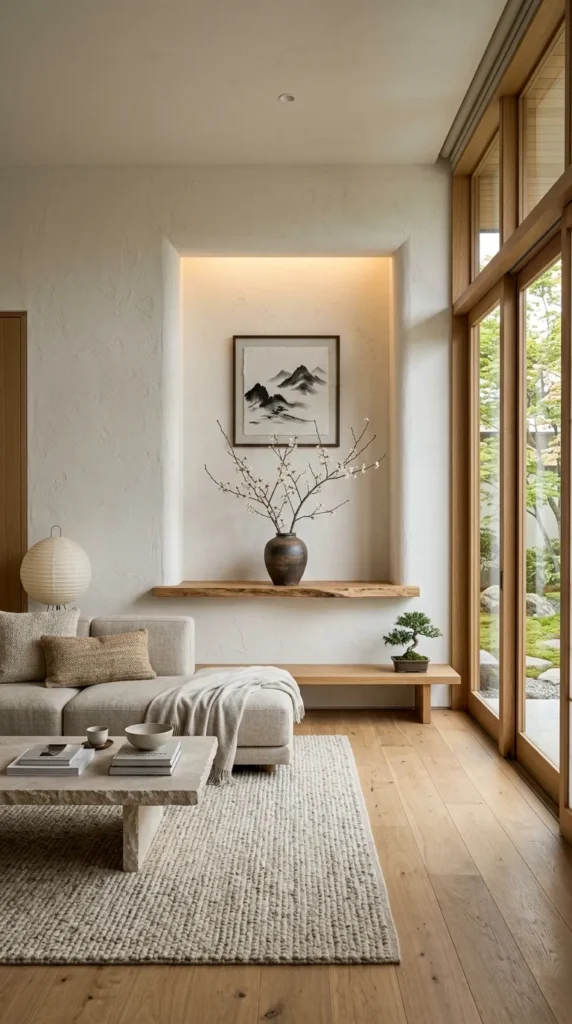
The tokonoma is the alcove found in traditional Japanese reception rooms where a single work of art, a flower arrangement, or a precious object is displayed as the room’s primary focal point and the visual expression of the season, the occasion, or the aesthetic sensibility of the household. It is a dedicated space for beauty, a place that exists not for practical function but for the contemplation of a single beautiful thing, and its presence in a traditional Japanese room communicates the value the household places on beauty as a genuine component of daily domestic life rather than as an optional extra.
Creating a tokonoma inspired focal point in a contemporary living room means designating one specific area of the room as a dedicated display zone and treating it with the same seriousness and the same seasonal attention that a traditional tokonoma would receive. This might be a low table against one wall with a single ceramic object and a simple flower arrangement placed on it. It might be an alcove between chimney breast and wall fitted with a single shelf at the right height for a rotating display of beautiful objects. It might be a section of wall left deliberately undecorated except for a single framed piece of calligraphy or a hanging scroll. The specific form is less important than the commitment to treating the focal point as a space of genuine contemplative intention rather than a convenient surface for whatever needs a home.
Complete your minimalist space with these 13 Living Room Color Schemes That Work for timeless, balanced color inspiration.
12. Incorporate Natural Fiber Rugs
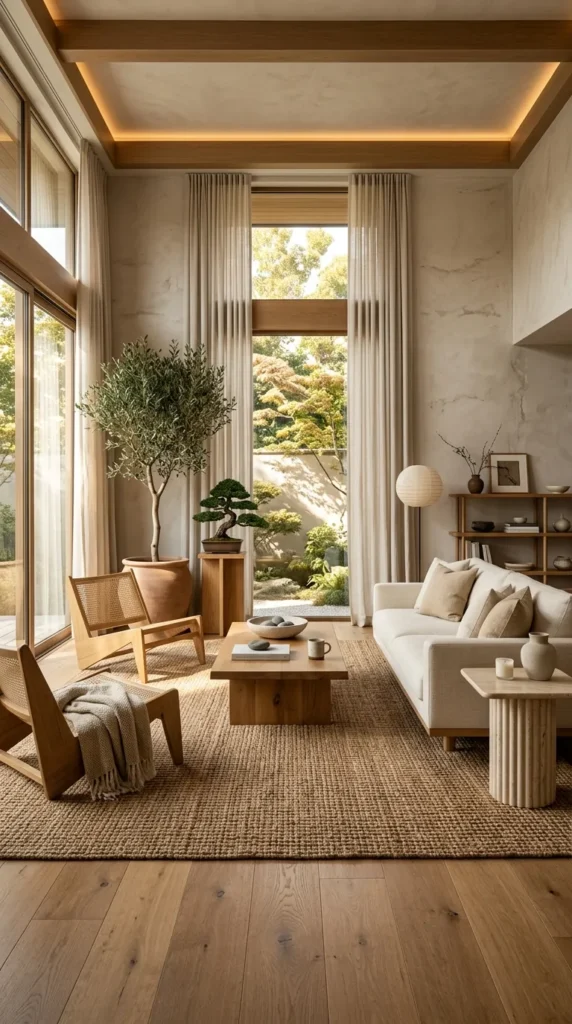
Natural fiber rugs in jute, seagrass, sisal, or wool create the floor surface that most completely suits a Japanese inspired living room because they bring the same qualities of material honesty and organic warmth to the floor that timber, stone, and ceramic bring to the other surfaces in the room. The woven texture of a natural fiber rug creates a surface of quiet visual interest at floor level that complements the overall tonal palette of the room without introducing a contrasting color or a decorative pattern that would compete with the restrained character of the Japanese aesthetic. The slight roughness of the fiber underfoot creates a tactile quality of genuine naturalness that synthetic rugs with their uniform softness cannot replicate.
Choose a natural fiber rug in a size that is genuinely large enough to anchor the entire seating area, with the front legs of all the seating pieces sitting on the rug rather than off it. A rug that is too small for the seating arrangement it is meant to anchor creates a disconnected quality between the floor surface and the furniture above it that undermines the grounded, unified character that the Japanese living room requires. In a room with timber flooring, a large natural fiber rug creates a layered floor surface of considerable warmth and material richness. In a room with stone or tile flooring, the rug provides the acoustic softness and the tactile warmth that hard floor surfaces alone cannot provide.
13. Choose Handmade Ceramic Accessories
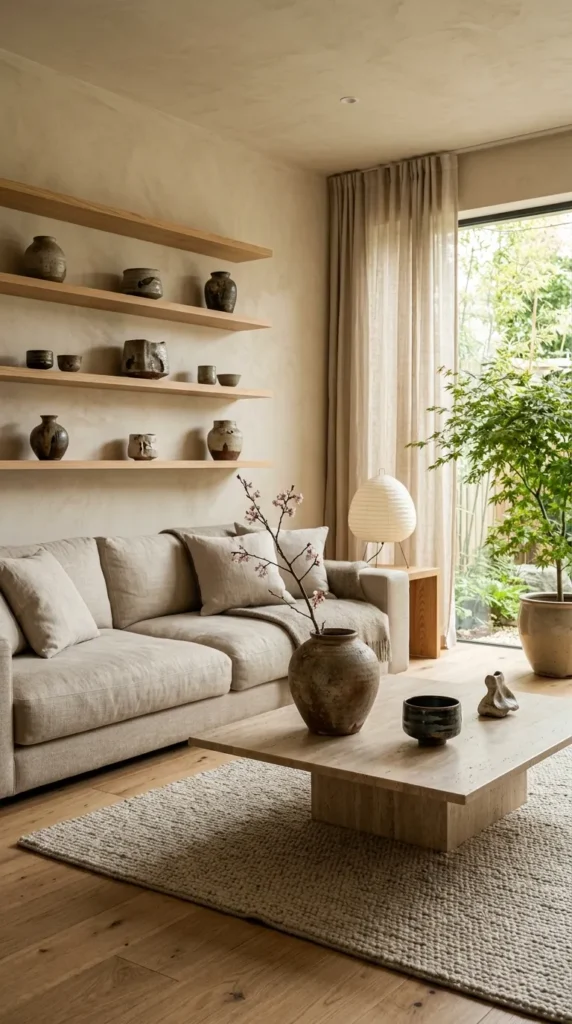
Handmade ceramics are the accessory category that most completely embodies Japanese aesthetic values and most effectively transforms the character of a living room when introduced with genuine intention and genuine selection. The slight irregularity of a hand thrown vessel, the variation in glaze depth and surface texture that results from the firing process, the visible mark of the maker’s hand in the form and the finish, all of these qualities communicate the wabi sabi aesthetic, the beauty of imperfection and the evidence of human making, more directly and more honestly than any other category of domestic object.
Japanese ceramic traditions produce vessels of extraordinary beauty in a very wide range of forms, glazes, and aesthetic sensibilities, from the austere simplicity of unglazed stoneware to the complex surface quality of wood fired ash glazes to the delicate refinement of porcelain in pale celadon or warm off white. Collecting a small number of genuinely handmade ceramic pieces for the living room, chosen for their individual beauty and for their relationship to each other and to the room, creates a display of considerable character and considerable warmth. Display them with generous space around each piece, on a low table, on a simple timber shelf, in a clear position where the light reaches them and their surface quality can be appreciated from the primary seating position in the room.
14. Design for Seasonal Change
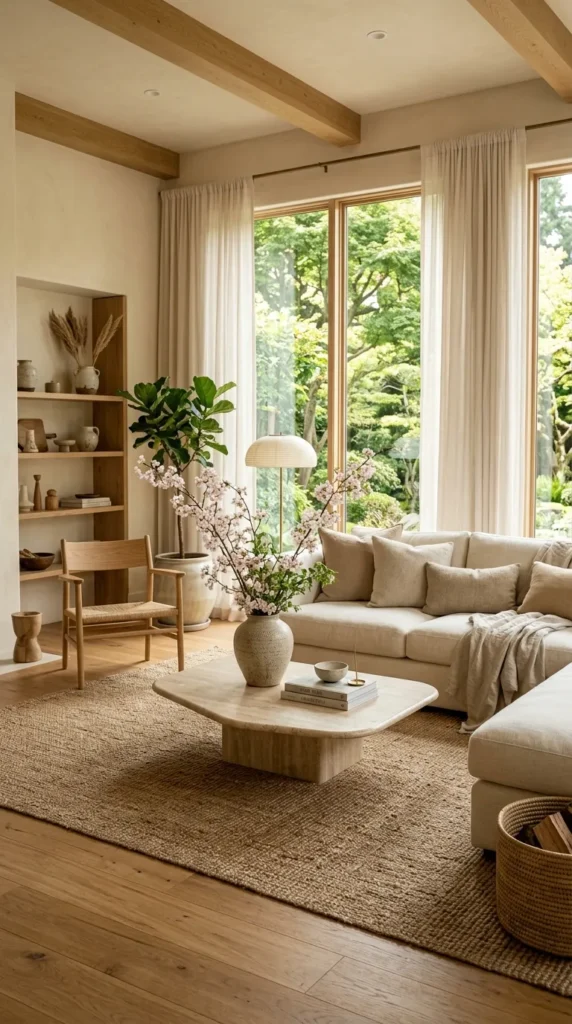
One of the most beautiful and most distinctive qualities of Japanese domestic design is its sensitivity to seasonal change and its commitment to allowing the interior of the home to reflect the character of the natural world outside at each season of the year. The tokonoma display changes with the season. The textiles in the room change from lighter, cooler materials in summer to heavier, warmer ones in winter. The flowers and branches displayed in the room are those that are currently in season in the natural landscape outside. The overall effect is a living room that never feels static or fixed but that participates in the rhythm of the natural year in a way that creates a genuinely alive and genuinely present quality of domestic beauty.
Designing for seasonal change in a contemporary living room is one of the most rewarding design practices available because it creates a reason to engage actively with the room on a regular basis rather than leaving it unchanged from one year to the next. Change the cushion covers from linen in summer to wool in winter. Replace the branches in the ceramic vessel from spring blossom to autumn berries to winter pine as the seasons progress. Introduce a scent that suits the season through a candle or a diffuser, fresh and green in spring and summer, warm and woody in autumn and winter. These changes cost very little and require very little time, but they create a living room that feels genuinely alive and genuinely connected to the world outside its walls, which is one of the deepest and most lasting pleasures that Japanese design has to offer.
Creating Your Japanese Inspired Living Room
The Japanese living room at its best is not a collection of Japanese objects in a Western room. It is a space that has been genuinely transformed by Japanese principles of simplicity, material honesty, seasonal sensitivity, and respect for empty space into something that feels fundamentally different in character from the rooms that surround it. This transformation happens through subtraction as much as addition, through the discipline of removing what is unnecessary as much as through the pleasure of choosing what is genuinely beautiful.
Begin with the principles rather than the objects. Create space before you add anything. Choose natural materials wherever a choice exists. Resist the temptation to fill every surface and decorate every wall. Bring in one genuinely beautiful handmade object and give it the space to be seen. These small commitments, made consistently and patiently, create a living room of genuine Japanese inspired character that rewards daily inhabitation with the quality of calm and beauty that this extraordinary design tradition has been creating for centuries.