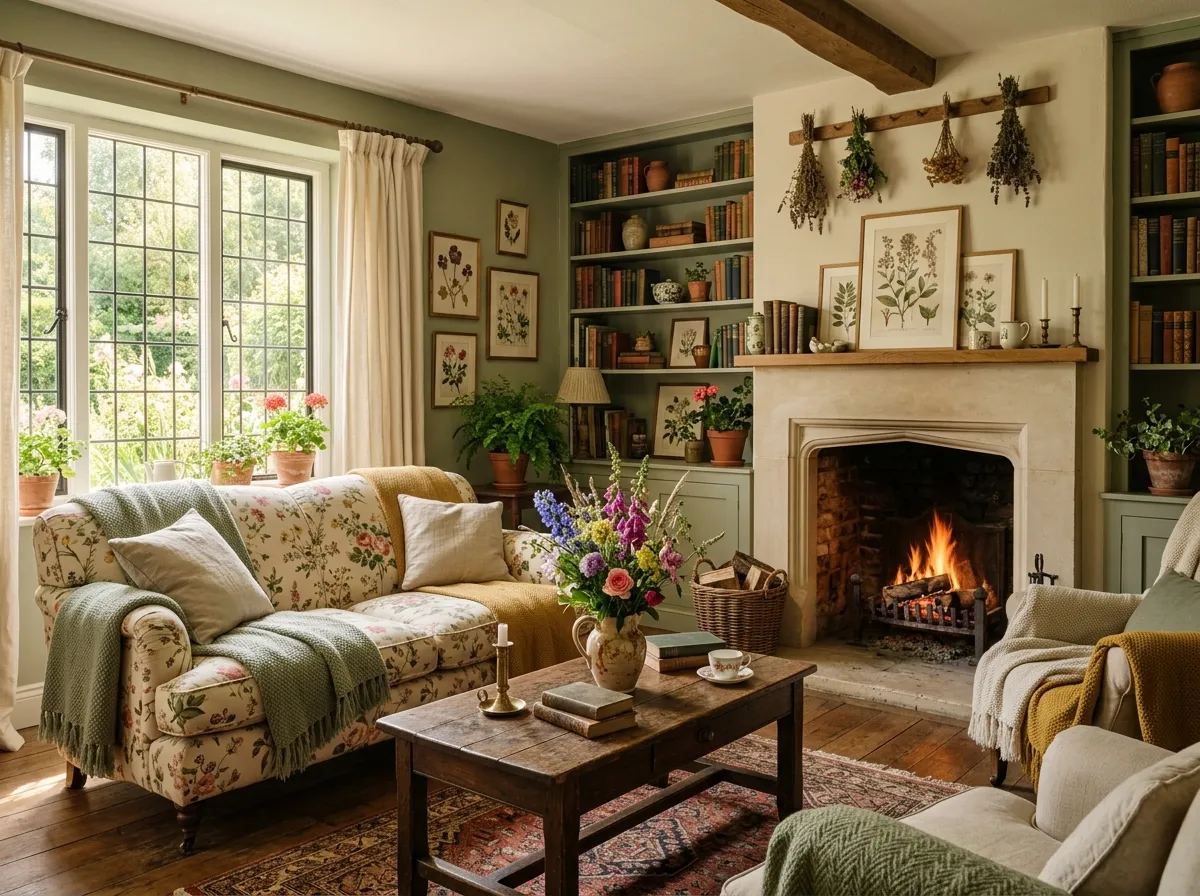
14 Cottagecore Living Room Ideas for a Cozy Home
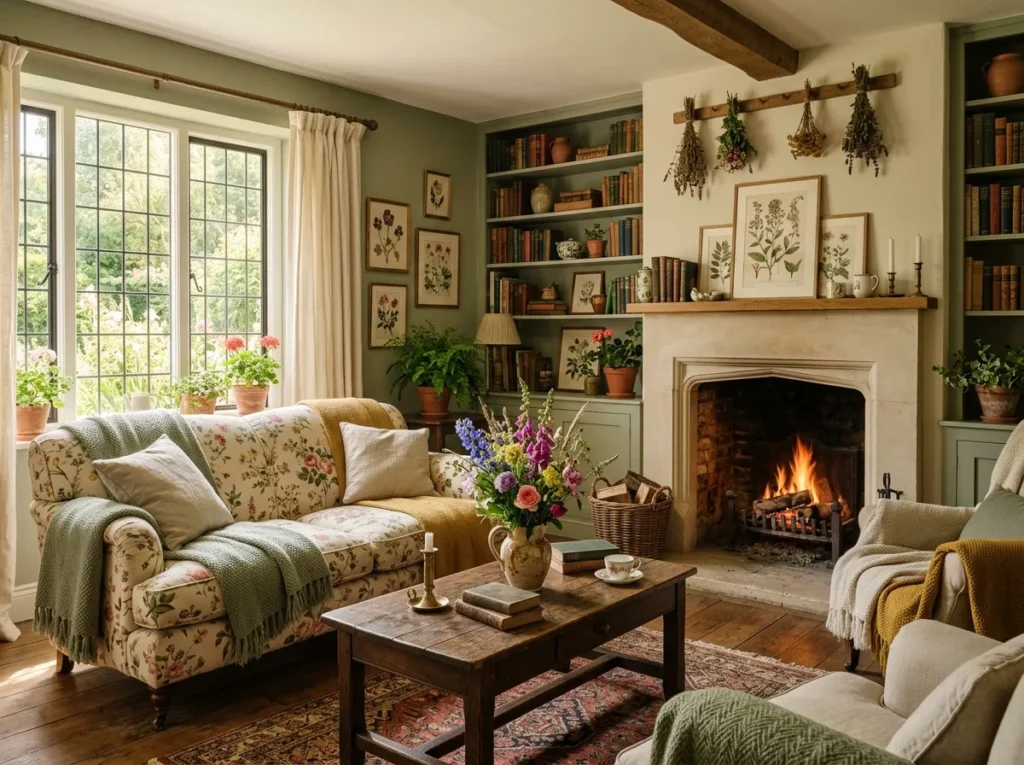
Cottagecore is one of those aesthetic movements that resonates so deeply and so widely because it taps into something genuinely universal, the longing for slowness, for natural beauty, for a domestic life that feels connected to the seasons and the earth rather than to screens and schedules and the relentless pace of contemporary existence. The cottagecore living room is not a museum of rural nostalgia. It is a genuinely livable space that brings the warmth of a countryside cottage, the abundance of a summer garden, and the coziness of a room that has been slowly and lovingly filled with beautiful things over many years into a contemporary home. It feels like somewhere you could spend an entire rainy afternoon with a pot of tea and a good book and feel that you have spent the day exactly right.
The beauty of cottagecore as a design aesthetic is its generosity. It does not require a thatched roof or a stone fireplace or a garden filled with hollyhocks to be genuine. It requires an attitude toward domestic beauty that values the handmade over the manufactured, the natural over the synthetic, the layered and accumulated over the minimal and curated, and the warm and imperfect over the cool and flawless. These fourteen ideas translate that attitude into specific, practical decisions that any living room can accommodate regardless of its size, its location, or its architectural character.
1. Fill the Room With Wildflower Arrangements
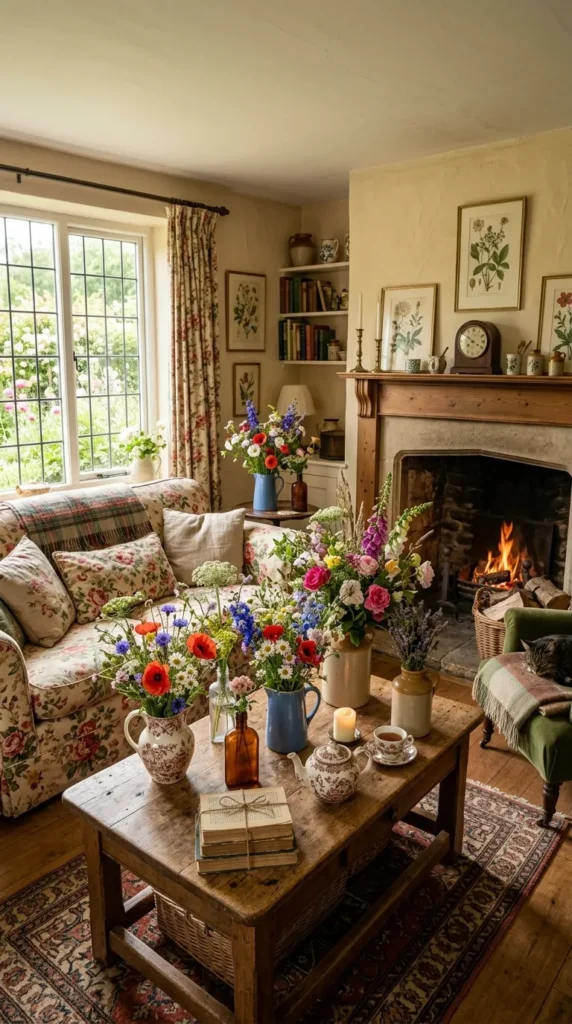
Flowers are the soul of the cottagecore living room, and not the carefully arranged, florist perfect bouquets of formal decoration but the loose, abundant, slightly informal arrangements of wildflowers and garden flowers that look as though they were gathered from the garden on a summer morning and placed in whatever vessels happened to be nearest to hand. Foxgloves, sweet peas, roses with their petals just beginning to open, lavender, chamomile, cornflowers, poppies, these are the flowers of the cottagecore aesthetic and their abundance in a living room creates an atmosphere of genuine natural beauty and seasonal connection that no other decorative element can replicate.
The vessels for cottagecore flower arrangements are as important as the flowers themselves. Mismatched vintage ceramic jugs in cream and blue and soft green. Old glass bottles in different sizes and different tints. Earthenware crocks whose glaze has the slight variation and imperfection of handmade pottery. Tin buckets with a patina of age and use. None of these needs to match any other, and the more varied and the more personally chosen the collection of vessels, the more authentic and the more beautiful the resulting floral display will be. Place arrangements throughout the room rather than in a single designated display zone, one on the coffee table, one on the windowsill, one on a side table, one on the mantelpiece, so that flowers are encountered at every turn and the room feels genuinely filled with the natural world rather than decorated with a token gesture toward it.
2. Choose Floral and Botanical Textiles
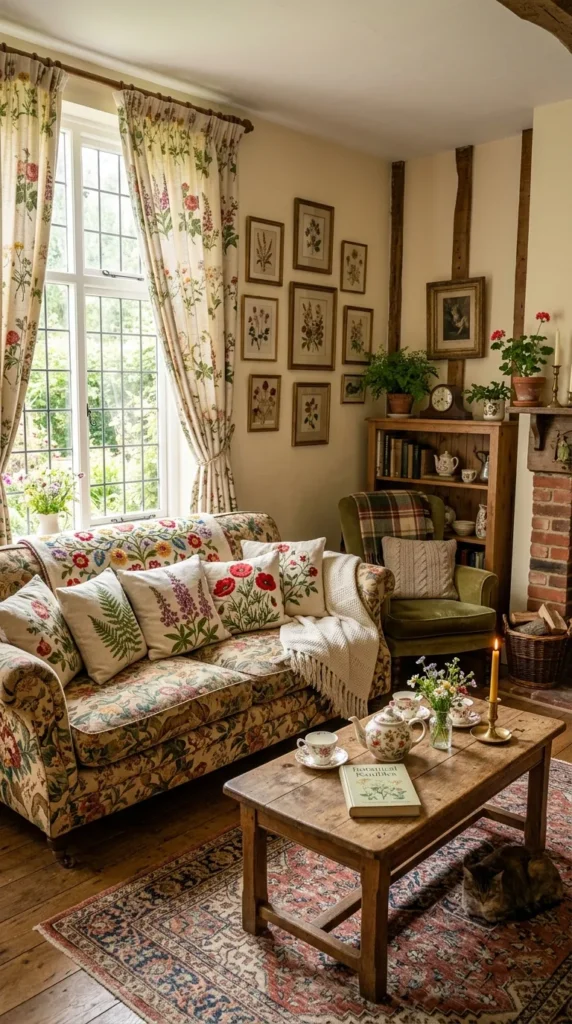
The textiles of a cottagecore living room are where the aesthetic finds its most characteristic and most immediately recognizable expression. Floral chintz on the sofa cushions. Botanical linen on the curtains. Embroidered cushion covers with their hand stitched flowers and leaves. A crewelwork throw with its woolly botanical motifs. A vintage tapestry with its forest creatures and flowering trees. These textiles bring the abundance and the beauty of the natural world into the living room in a way that is specifically cottagecore, specifically warm, and specifically the opposite of the plain, unpatterned textiles that contemporary minimalism has trained us to reach for.
The art of layering floral and botanical textiles in a cottagecore living room without creating visual chaos lies in managing scale and tone rather than in restricting the number of patterns. A large scale rose print on the sofa, a medium scale botanical on the curtains, a small scale all over floral on a pair of cushions, and a simple stripe on a throw all work together beautifully if they share a common tonal palette of warm creams, soft pinks, sage greens, and dusty blues. The patterns can differ wildly in their subject matter and their scale as long as they speak the same color language, and this tonal coherence is what allows the layered, maximally patterned textile environment of a cottagecore room to feel rich and beautiful rather than overwhelming and chaotic.
3. Bring In Aged and Weathered Furniture
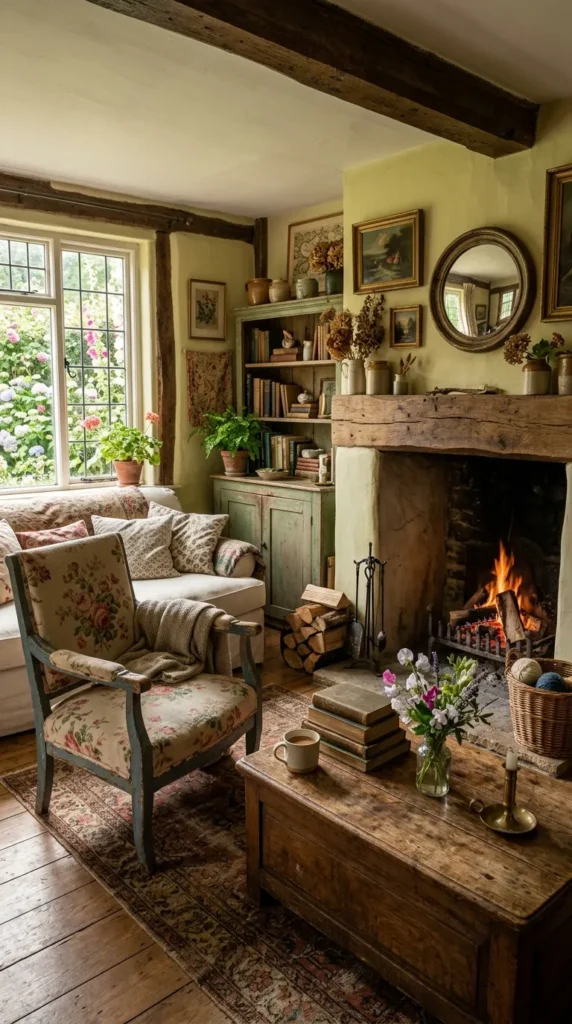
The furniture of a cottagecore living room has typically lived a life before it arrived in the room, and the evidence of that life, the worn edges, the slightly faded paint, the drawer that sticks a little and requires a specific technique to open, the chair whose seat cushion has been replaced more than once, all of these qualities are not problems to be corrected but characteristics to be appreciated. A piece of furniture that looks genuinely old and genuinely used carries a warmth and an authenticity that new furniture manufactured to look vintage cannot convincingly replicate, and the cottagecore aesthetic understands and celebrates this quality with a generosity that most contemporary design sensibilities lack.
Charity shops, estate sales, antique markets, and online vintage platforms are the natural hunting grounds for cottagecore furniture, and the search itself is one of the pleasures of assembling a cottagecore living room over time. A painted Welsh dresser whose cream paint has chipped to reveal an older layer of sage green beneath. A button back armchair in a faded floral fabric that has been repaired at the armrest with a slightly different but equally beautiful fabric. A wooden coffee table whose surface shows decades of use in every ring and scratch. These are the pieces that make a cottagecore living room feel genuinely inhabited and genuinely loved rather than recently assembled and carefully maintained at a level of perfection that no room intended for actual living can honestly sustain.
Love natural textures and reclaimed wood? Discover 13 Rustic Living Room Ideas for warm and inviting decorating inspiration.
4. Create a Maximalist Bookshelf
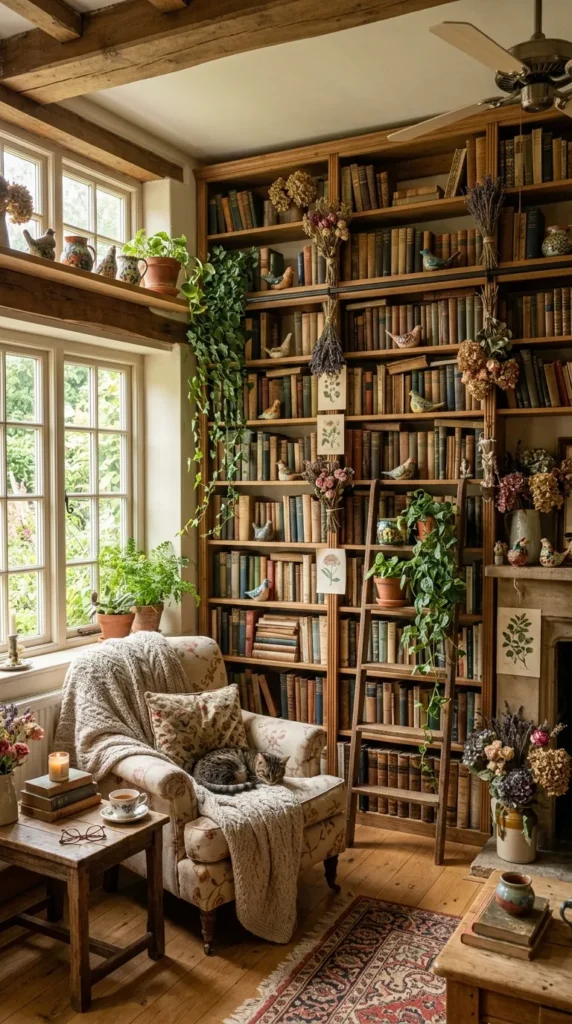
Books are as essential to the cottagecore living room as flowers and mismatched crockery, and a bookshelf that is genuinely full, genuinely varied, and genuinely reflective of an inquiring and widely ranging reading life is one of the most beautiful and most characteristic elements the aesthetic offers. The cottagecore bookshelf is not the carefully curated display of designer spines arranged by color that contemporary interior styling favors. It is a real working library whose organizational logic reflects the habits and the interests of the person who assembled it, where poetry sits next to foraging guides, where Victorian novels are wedged between wildflower identification books, where old cookbooks with handwritten annotations lean against collections of fairy tales.
A maximalist cottagecore bookshelf mixes books with objects in a way that creates a display of genuine personal character and genuine visual richness. Pressed flower specimens in small frames propped against book spines. Ceramic animals and birds tucked between volumes. Small potted plants growing in the patches of light that reach the shelves near a window. A collection of pebbles and shells gathered from meaningful places resting on the horizontal surfaces between upright books. Vintage bookmarks and dried flowers tucked into volumes as place markers. The resulting bookshelf is as much a self portrait as a storage solution, and in a cottagecore living room that is exactly what it should be.
5. Install Vintage Curtains or Make Your Own
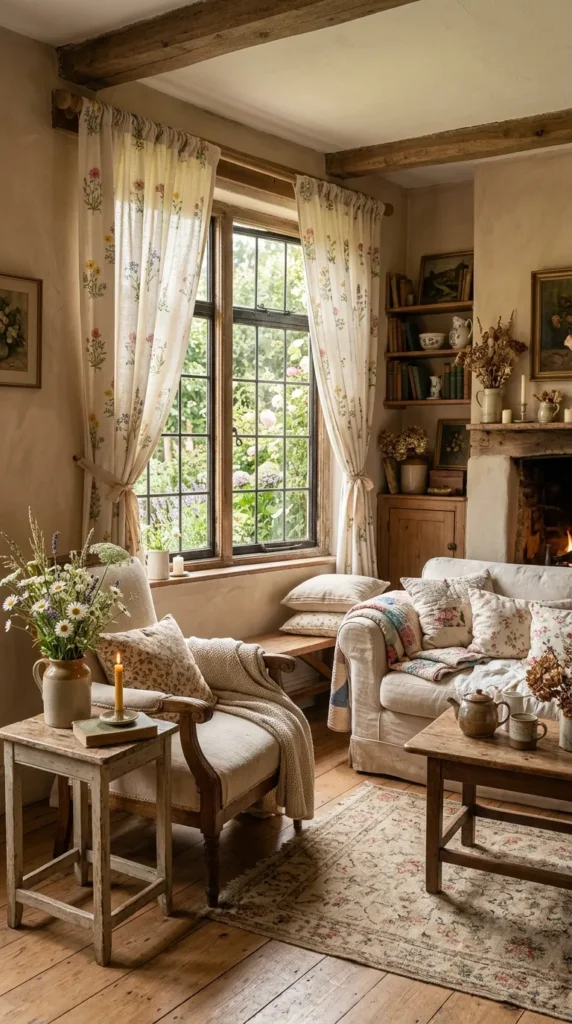
The curtains in a cottagecore living room are one of its most visually significant elements because they occupy a large proportion of the wall surface and contribute enormously to the overall textile character of the room. Vintage curtains in floral or botanical fabrics, found at estate sales, vintage markets, or online vintage textile platforms, bring an authenticity and a quality of aged material beauty that contemporary curtains in reproduction vintage fabrics cannot quite match. The slight fading of genuinely old fabric, the quality of light that falls through curtains that have been hanging at windows for decades, the subtle texture of vintage weaves, all of these create a curtain of real character and real warmth.
Making your own curtains from vintage fabric is one of the most genuinely cottagecore things you can do in a living room, and it is more accessible than it might initially seem. Vintage fabric by the meter is available from specialist textile dealers, vintage markets, and online platforms in a wide range of cottagecore appropriate prints and weaves, and simple unlined curtains require nothing more sophisticated than a straight seam and a heading tape to be genuinely beautiful and genuinely functional. The slightly imperfect finish of handmade curtains, the evidence of their making in every stitch, is not a shortcoming but a genuine aesthetic advantage in a room that values the handmade over the manufactured and the personal over the standardized.
6. Use Vintage China and Ceramics as Display
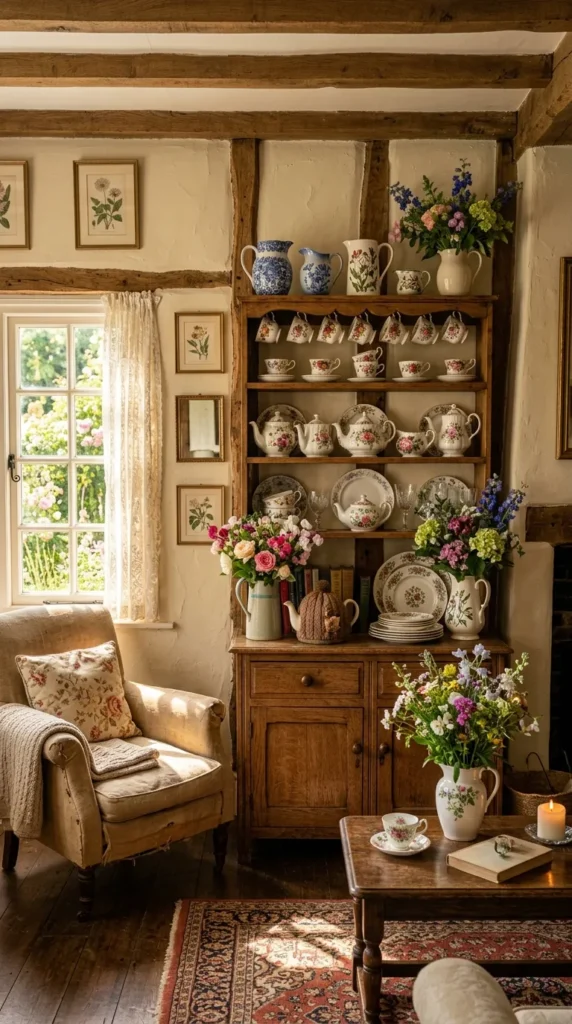
The display of vintage china and ceramics is one of the purest expressions of the cottagecore aesthetic available to a living room, because it combines the beauty of handmade or historically crafted objects with the abundance and the personal accumulation that the aesthetic values so highly. A Welsh dresser or open shelving unit filled with mismatched vintage plates, cups and saucers, jugs, teapots, and ceramic figures creates a display of extraordinary warm visual richness that communicates a life of engaged collecting and genuine appreciation for the domestic arts. The pieces do not need to match. In fact, the more varied they are in period, in pattern, and in provenance, the more authentic and the more beautiful the resulting display becomes.
Blue and white transferware from the nineteenth century. Creamware with its warm off white glaze. Floral china from the 1930s and 1940s in the soft pastels of that decade. Studio pottery from the mid twentieth century with its expressive glazes and hand formed shapes. Cottage industry ceramics with their slightly naïve painted decoration. All of these belong naturally in a cottagecore display and all are available at very modest prices from the sources that yield vintage finds consistently. Display them densely rather than sparingly, filling the shelves generously and allowing the visual abundance of the collection to create the warm, characterful quality that sparse, minimally styled display cannot achieve.
7. Add a Window Seat With Cushions
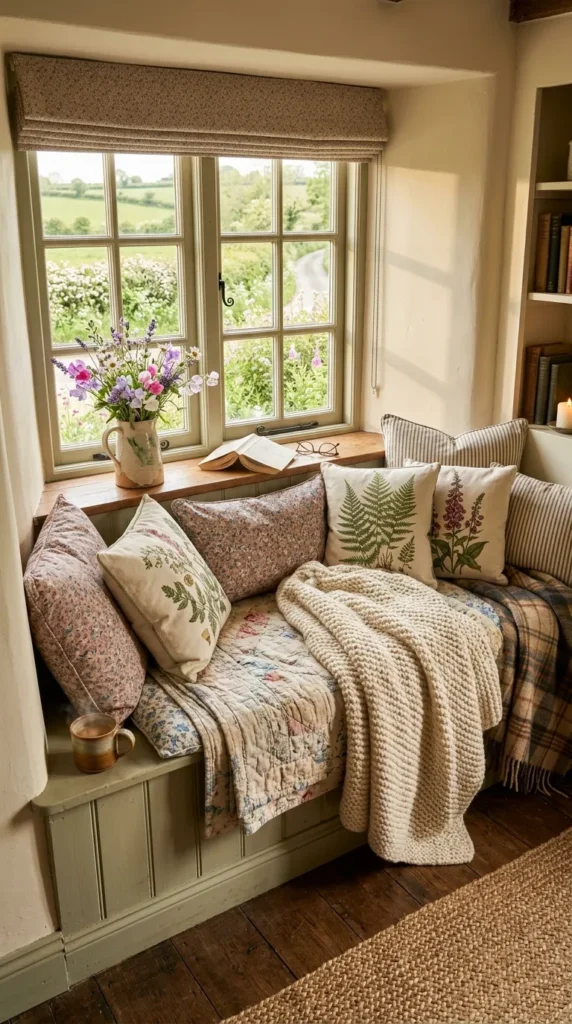
A window seat, whether built into a genuine window alcove or created by placing a low bench or daybed in front of a window and dressing it with cushions and throws, is one of the most quintessentially cottagecore living room elements available and one of the most genuinely pleasant places to spend time in any domestic setting. The combination of natural light from the window, the softness of the cushioned surface beneath, the view of whatever lies outside the window whether garden or street or sky, and the slightly enclosed, nest like quality of a seat that is defined by its relationship to a specific architectural opening creates a seating position of extraordinary appeal and extraordinary domestic pleasure.
The cushions and textiles on a cottagecore window seat should be as layered and as varied as any other textile zone in the room. A deep cushion in a botanical linen as the primary seat pad. Multiple cushions of different sizes and different floral or botanical patterns arranged against the window reveals or against a wall if the seat runs parallel to it. A soft throw in a warm wool or a knitted cotton draped over one end. A small pillow embroidered with a botanical motif propped in a corner. The window seat dressed this way becomes a destination within the living room, a specific place with a specific quality of light and comfort and enclosure that draws people to it instinctively and rewards them with the particular pleasure of a seat that feels made specifically for the act of looking out at the world while remaining warmly and comfortably within it.
8. Hang Botanical Art and Nature Prints
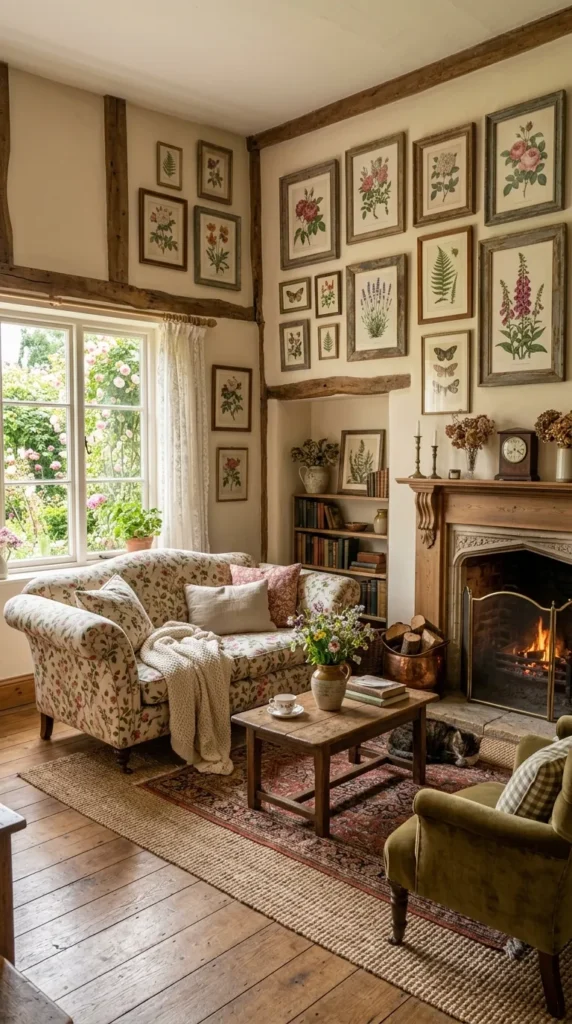
The walls of a cottagecore living room carry a specific category of art that is as characteristic of the aesthetic as the floral textiles and the vintage ceramics. Botanical illustrations, the precise and beautiful drawings and paintings of plant species produced in the scientific illustration tradition of the eighteenth and nineteenth centuries, are the art form most naturally suited to the cottagecore living room because they combine genuine artistic beauty with the natural subject matter that the aesthetic values so highly. A collection of framed botanical prints covering a significant portion of one wall creates a display of extraordinary warmth and historical character that suits the cottagecore room perfectly.
Genuine antique botanical prints are available at very modest prices from print dealers, antique markets, and online vintage platforms because the supply is genuinely abundant. The frames are often as beautiful as the prints themselves, and mismatched frames in gilt, in painted timber, in simple natural wood, create a salon style hanging of considerable charm and visual variety when grouped together with generous spacing between individual pieces. Supplement botanical prints with other nature themed imagery, bird studies in the natural history illustration tradition, landscape watercolors, pressed flower specimens in simple frames, vintage seed catalogue illustrations, and the wall becomes a celebration of the natural world that is completely characteristic of the cottagecore sensibility at its warmest and most beautiful.
9. Incorporate Handmade and Craft Objects
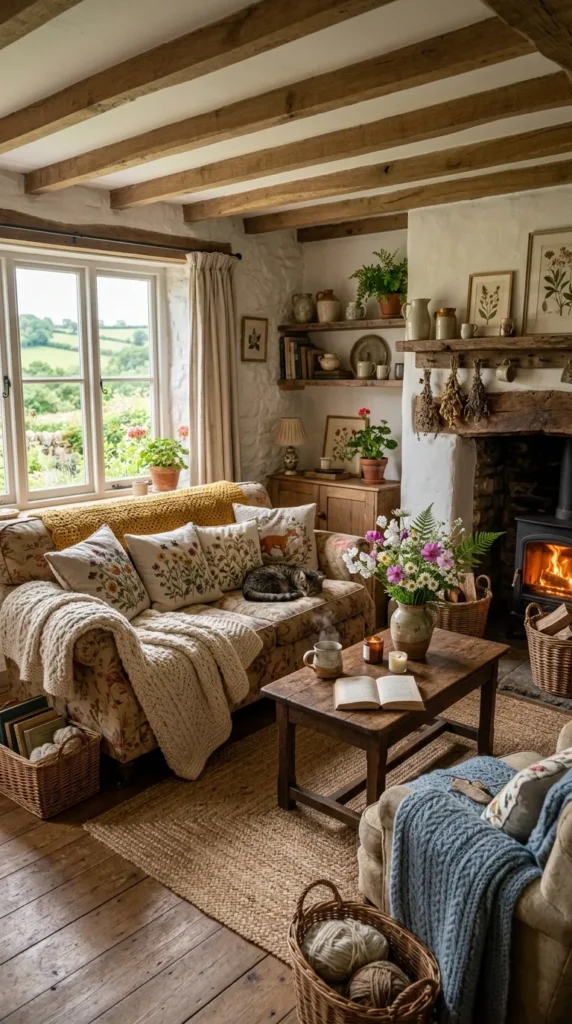
The handmade object is at the heart of the cottagecore aesthetic in a way that goes beyond mere decorative preference into something closer to a set of values about the relationship between human beings and the things they make and use. A knitted blanket whose maker you know. A ceramic mug thrown by a potter whose studio you have visited. An embroidered cushion whose stitches you made yourself on winter evenings. A basket woven from rushes gathered from a local waterway. These objects carry a quality of human presence and human care that manufactured objects, however beautifully designed, simply do not possess, and their presence in a living room creates an atmosphere of genuine warmth and genuine connection that cannot be purchased from a shop.
Making things for your cottagecore living room is one of the most genuinely satisfying expressions of the aesthetic available, and the range of making skills relevant to the cottagecore interior is wide enough to suit almost any level of craft ability. Simple embroidery on linen cushion covers. Basic knitting producing cushion covers, throws, or small decorative objects. Simple macramé wall hangings or plant hangers. Dried flower wreaths and arrangements made from garden or hedgerow materials. Painted furniture using chalky paints in botanical tones. Any of these crafts produces objects of genuine cottagecore character whose handmade quality communicates the values of the aesthetic more directly and more honestly than any purchased object however well chosen.
10. Use Earthy and Botanical Paint Colors
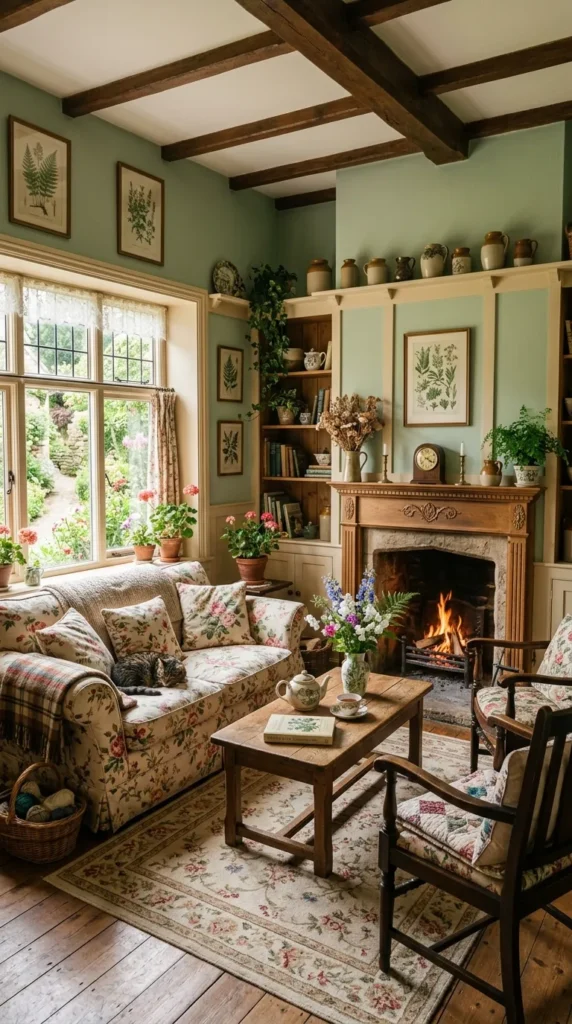
The paint colors of a cottagecore living room are drawn from the natural landscape and from the interior of the country cottage that provides the aesthetic’s central reference point. Sage green, the color of dried herbs and lichen covered stone. Warm cream, the color of fresh plaster and old linen. Dusty rose, the color of faded damask and dried lavender. Soft terracotta, the color of unglazed earthenware and sun warmed brick. Cornflower blue, the color of summer sky and wild chicory flowers. These colors are warm rather than cold, complex rather than simple, and slightly muted rather than saturated, with the gentle quality of pigments softened by age and light exposure.
The application of botanical paint colors in a cottagecore living room works best when the color is used with generosity rather than restraint. A single accent wall in sage green in an otherwise neutral room creates a contemporary effect that does not quite achieve the immersive warmth of the cottagecore aesthetic. Sage green on all four walls, on the ceiling in a slightly lighter version of the same tone, on the woodwork in a deeper and richer version, creates a room that feels genuinely enveloped in the color, genuinely connected to the botanical reference it makes, and genuinely different in atmosphere from the neutral palette that most contemporary rooms default to. The cottagecore room commits to its colors with the same enthusiasm and the same generosity that it commits to its patterns and its abundance of natural objects.
11. Layer Rugs for Warmth and Pattern
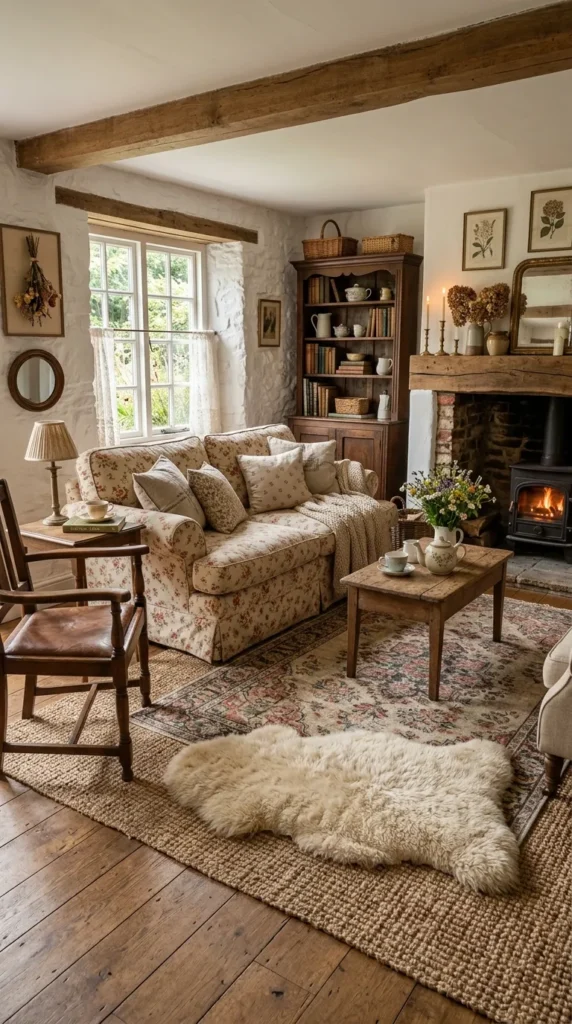
Layering rugs in a cottagecore living room, placing one rug on top of another to create a composite floor surface of combined texture, pattern, and warmth, is one of the most effective and most genuinely cottagecore approaches to the living room floor. A large natural jute or sisal rug as the base layer provides the neutral, natural material foundation. A smaller vintage floral or botanical patterned rug placed on top provides the color, the pattern, and the visual interest that the cottagecore room requires. A sheepskin or faux fur thrown across one corner of the top rug adds a layer of tactile softness and animal warmth. The three layers together create a floor surface of extraordinary richness that no single rug regardless of its beauty can approach.
The rugs used in cottagecore layering do not need to coordinate in the formal sense of sharing a specific color or pattern. They need to share a tonal warmth and a material honesty that creates coherence at a more fundamental level than deliberate coordination achieves. A warm jute base, a faded floral kilim on top, and a cream sheepskin in one corner all work together beautifully because they share the earthy, natural quality of materials that come from the land rather than from a factory, and this shared material character creates a layered floor surface that feels organically unified rather than deliberately assembled.
Add timeless character to your home with these 16 Vintage Living Room Ideas for beautifully collected interiors.
12. Create a Cozy Fireside Seating Area
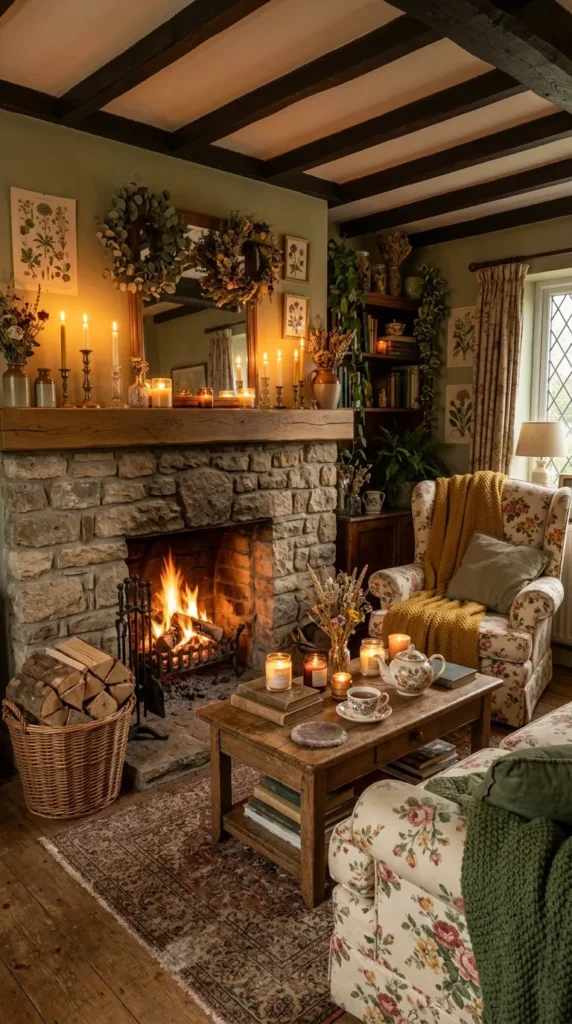
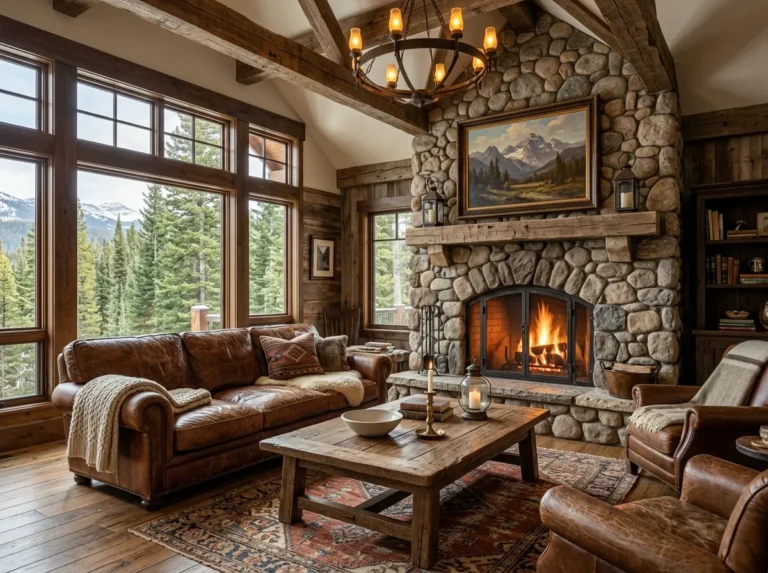
The fireplace in a cottagecore living room is its beating heart, the element around which everything else in the room is arranged and from which the room’s warmth, both literal and atmospheric, radiates outward. A cottagecore fireside seating area, with two armchairs or a sofa and a single armchair arranged to face the fire at a comfortable distance, a small table between them for mugs and books, a basket of logs within reach, a hearthrug in front of the grate, and a mantelpiece above dressed with a collection of beautiful objects, creates a seating zone of extraordinary domestic pleasure that is the living expression of everything the cottagecore aesthetic values.
The mantelpiece above a cottagecore fireplace is one of the most important display surfaces in the room and one that rewards genuine attention to how it is styled. A large aged mirror or a botanical painting in a gilt frame as the primary vertical element. Ceramic pieces of different heights creating a varied skyline across the mantelpiece shelf. Fresh or dried flower arrangements bringing natural material into the composition. Candles in different heights grouped together. A collection of small meaningful objects, a favourite pebble, a bird’s feather, a pressed flower in a tiny frame, adding personal significance to the beauty of the display. The resulting mantelpiece composition communicates the character and the sensibility of the household with more clarity and more warmth than any other single surface in the room.
13. Hang Dried Flowers and Herb Bundles
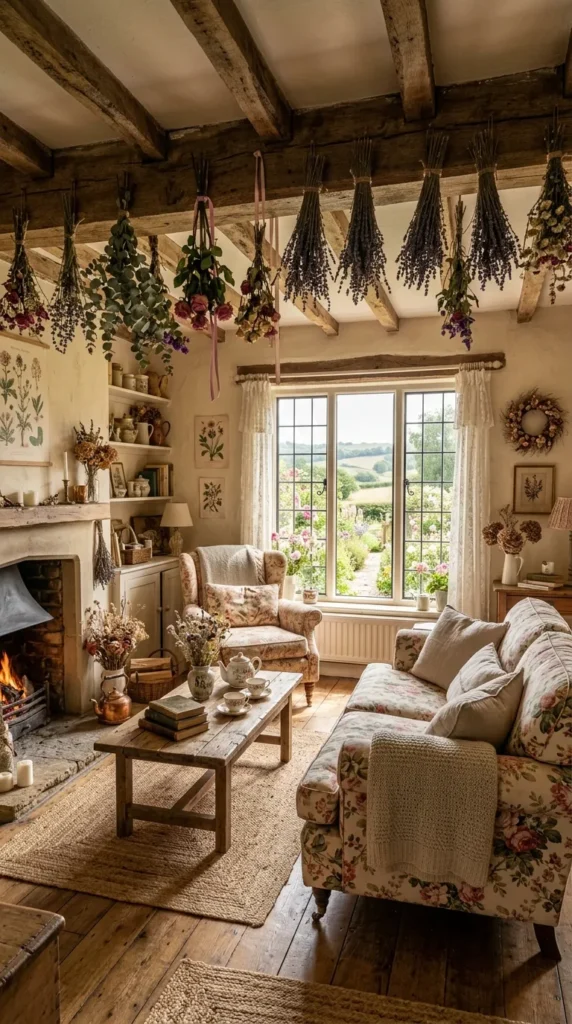
Dried flowers and herb bundles hung from beams, from curtain poles, from picture rails, or from dedicated hooks on the wall bring the cottagecore room’s connection to the natural world into its most literal and most beautiful expression. Lavender bundles tied with faded ribbon. Bunches of dried roses in cream and pink and soft red. Eucalyptus stems in their silvery grey green. Dried hydrangea heads whose colors have softened from their original intensity to something more subtle and more beautiful. Bundles of rosemary and thyme and sage whose fragrance fills the room with the scent of the kitchen garden. All of these dried natural materials bring texture, color, fragrance, and genuine organic beauty to the cottagecore living room.
The hanging of dried flowers and herbs in a living room is one of the most genuinely hand made and most genuinely seasonal decorating practices available to the cottagecore enthusiast, because the materials are gathered or purchased fresh and hung to dry in the room itself, their transformation from living to dried being part of their decorative journey rather than a process completed elsewhere before their arrival in the room. A bunch of fresh lavender tied to a hook on the wall perfumes the room as it dries and creates a display that is visually beautiful through every stage of its transformation. The same is true of roses, of eucalyptus, of most of the botanical materials that suit this kind of display, and the practice of hanging fresh flowers to dry in the living room connects the room to the natural cycle of growth and drying in a genuinely cottagecore way.
14. Embrace an Abundance of Houseplants
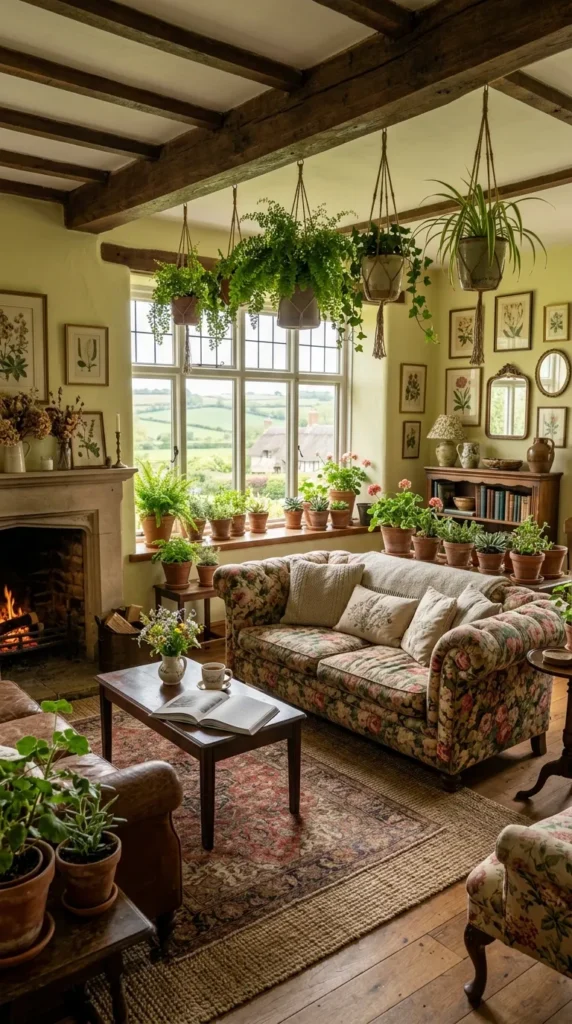
Plants in a cottagecore living room are present in an abundance that reflects genuine enthusiasm for living things rather than a design decision about the appropriate number of plants for a room of this size and this style. Every windowsill has plants growing in a variety of ceramic and terracotta pots. Every available shelf surface hosts a plant or two alongside the books and the ceramics. The floor in corners and beside the fireplace holds larger plants in generous containers. Trailing plants hang from ceiling hooks and cascade over the edges of high shelves. The overall effect is one of a room that has been gradually colonized by growing things, that feels more like a garden room than a conventional living room, and that breathes with the particular quality of calm and vitality that an abundance of living plants uniquely creates.
The plant choices that suit a cottagecore living room are those that feel connected to the cottage garden and the rural landscape rather than to the tropical or the exotic. Ferns in their many varieties, from the delicate maidenhair to the bold Boston fern, have an association with the damp, shaded spots of the English countryside that makes them feel completely natural in a cottagecore setting. Pelargoniums with their scented leaves and their cheerful flowers suit a sunny cottagecore windowsill as perfectly as they suit the windowsills of actual country cottages. Herbs in terracotta pots on the kitchen windowsill are equally at home on a living room windowsill in a cottagecore room where the boundary between the kitchen and the living space is porous and the fragrance of growing rosemary and thyme is as welcome in the sitting room as it is in the kitchen.
Creating Your Cottagecore Living Room
The cottagecore living room is built on a philosophy rather than a shopping list, and the philosophy is simple enough to state even if it takes time and genuine attention to apply. Choose the natural over the synthetic. Choose the handmade over the manufactured. Choose the aged and imperfect over the new and flawless. Choose abundance over restraint. Choose warmth over coolness. Choose pattern over plain. Choose seasonal change over the static perfection of a room that never evolves because it has been designed to be finished rather than to be lived in.
Apply these principles consistently across every decision in the living room, from the paint color on the walls to the fabric on the sofa to the objects on the shelves to the flowers on the coffee table, and the room will develop its own genuine cottagecore character over time, becoming more beautiful and more personally expressive with every season that passes and every new beautiful thing that finds its way into it. This is the real pleasure of the cottagecore living room, not the result but the process, the ongoing practice of attending to beauty in natural and imperfect things and creating a domestic space that reflects that attention with warmth and with joy.