15 Toy Storage Ideas for a Beautiful Living Room
Every parent who has ever stepped on a Lego brick in bare feet at eleven o’clock at night knows the particular frustration of a living room that has been completely taken over by toys. The plastic figures on every surface, the board games with missing pieces stacked against the wall, the basket of stuffed animals that somehow multiplies overnight, the puzzle pieces that migrate into sofa cushions and never fully return toy chaos in a living room is not just visually exhausting, it is emotionally exhausting, because it creates the constant low-level feeling that the space is out of control and that no amount of tidying will ever quite resolve it. The problem is rarely the toys themselves. Children need toys, and children who spend time in the living room will inevitably bring their toys with them, because that is where the family is and children want to be where the family is. The problem is the absence of a storage system that is genuinely easy enough for children to use independently, generous enough to contain a realistic quantity of toys, and beautiful enough to sit in a living room without making the space feel like a playroom that accidentally has a sofa in it.
The toy storage solutions that work in a living room are the ones that solve all three of these problems simultaneously rather than trading one against another. A beautiful storage ottoman that a three-year-old cannot open independently solves the aesthetic problem while creating a practical one. A row of open bins that a toddler can use perfectly well looks chaotic and toyroom-institutional in a living room that you also want to feel like an adult space. A toy chest that requires full excavation to find any specific item discourages tidying because the act of putting things away guarantees that everything else will be disturbed in the process of taking them out again. The fifteen toy storage ideas in this article have been selected because they genuinely address all three requirements function, ease of use, and visual integration with the living room and because each one represents a real solution to a real problem that families with children in the living room face every single day.
1. A Large Wicker Basket With a Lid for Quick Tidy-Ups
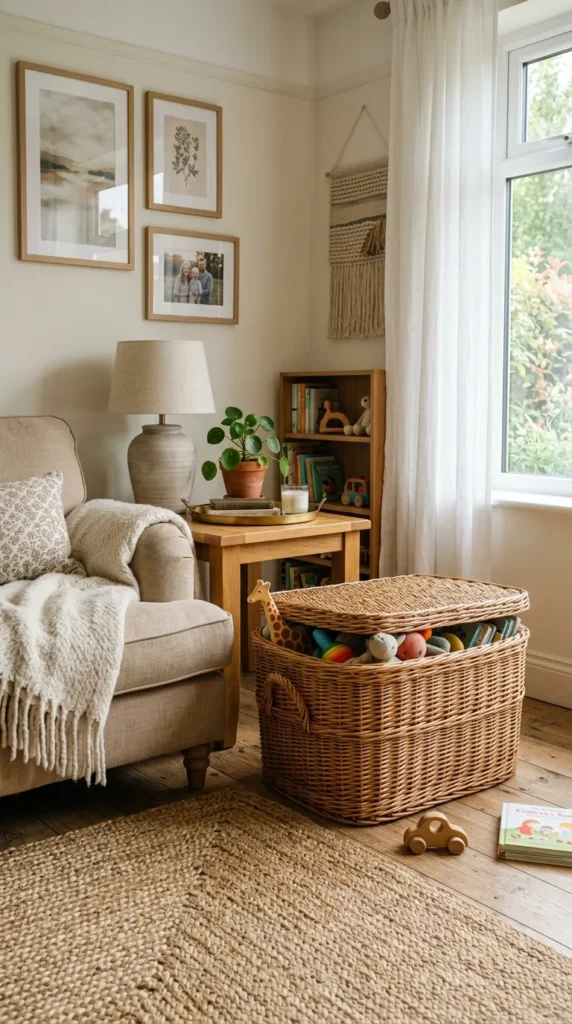
The lidded wicker basket is the toy storage solution that requires the least commitment, the least installation, and the least design decision-making, and yet delivers a genuinely significant improvement to a living room overwhelmed by toys. A large wicker or rattan basket big enough to hold a meaningful quantity of toys, with a fitted lid that conceals the contents completely when closed placed in a corner of the living room or beside the sofa creates an immediate and accessible destination for toys that need to be gathered quickly before guests arrive, before the room needs to function as an adult space, or simply at the end of the evening when the day’s play is over. The lid is the critical feature: without it, an open basket of toys reads as visual clutter even when neatly organized, because the eye sees the toys and the brain registers the mess. With the lid closed, the basket reads as a decorative object a beautiful natural material piece that suits virtually any living room aesthetic from coastal to contemporary to eclectic and the toys inside it cease to exist visually.
The practical strength of a lidded wicker basket is its accessibility to children of almost any age a two-year-old can lift a wicker lid, drop a toy inside, and replace the lid with minimal assistance, which means that the tidying habit can be established early and maintained independently without adult intervention for every individual item. Choose a basket whose interior dimensions are genuinely generous at least 50 by 40 centimeters and 40 centimeters deep so that a realistic evening’s worth of toys can be gathered into it without requiring careful organization or compression. Natural rattan and seagrass baskets in warm honey tones suit living rooms with natural material palettes, while painted or whitewashed wicker suits cleaner, more contemporary spaces. A matching pair of baskets creates more storage capacity while looking more designed and intentional than a single basket of equivalent volume.
2. A Storage Ottoman That Works as a Coffee Table
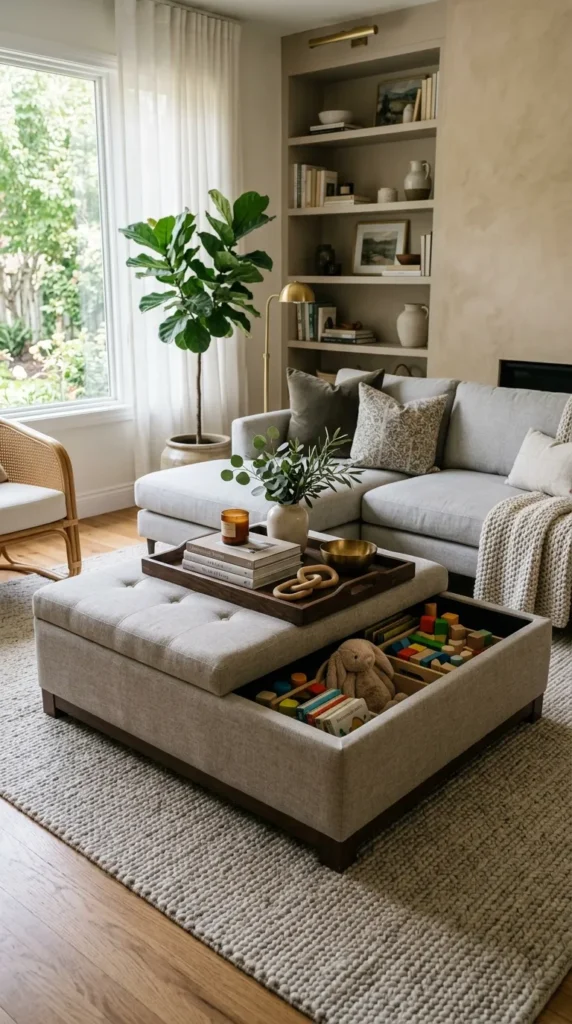
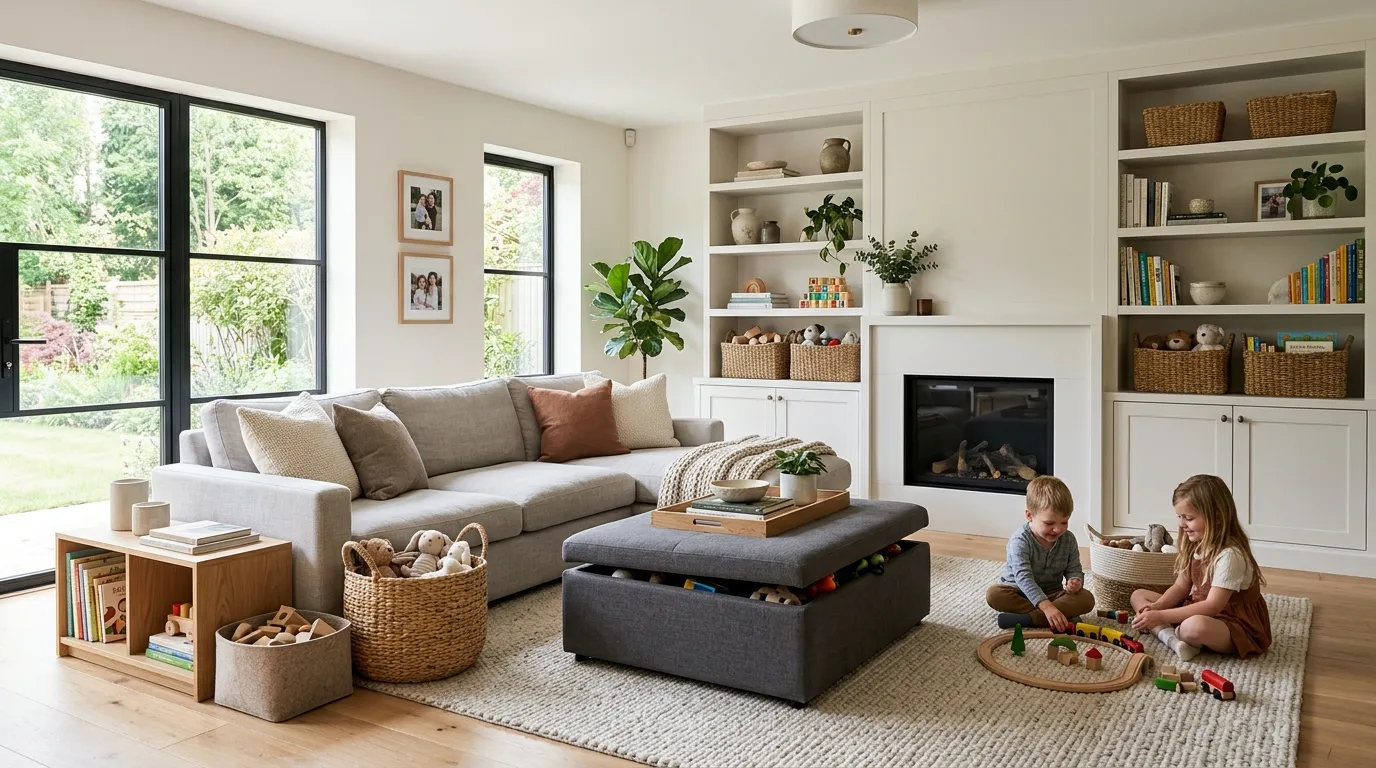
The storage ottoman is perhaps the most elegant toy storage solution available to a living room, because it conceals its function so completely that most guests would never identify it as toy storage at all. A large, well-upholstered ottoman with a hinged or removable lid serves simultaneously as a coffee table surface, as additional seating when required, and as a cavernous storage space for toys, games, and the accumulated soft furnishings extra blankets, spare cushions that living rooms tend to collect. When the lid is closed and a tray with a candle and a plant sits on its surface, it looks like a considered design choice. When the lid is open and a child is fishing out a specific toy from the pile inside, it functions perfectly as accessible, child-friendly storage. This dual identity beautiful object by day, practical storage at all times is what makes the storage ottoman one of the highest-value pieces of furniture available to a family living room.
The upholstery choice for a storage ottoman in a family living room requires realistic thinking about how the piece will be used and what it will be subjected to. Velvet and silk are beautiful and impractical they mark easily, clean with difficulty, and will look worn within a year of regular family use. Performance fabrics those specifically engineered to resist staining, moisture, and abrasion while maintaining a soft, natural appearance are the honest choice for family living rooms, and the range of performance fabric options available has expanded enormously in recent years to include convincing versions of linen, velvet, and bouclé textures that suit most living room aesthetics. Choose an ottoman large enough to be genuinely useful as both a surface and a storage vessel at least 100 by 60 centimeters for a sofa-sized living room and position it where it naturally anchors the seating arrangement rather than where it merely fills a gap.
3. Built-In Shelving With Dedicated Toy Baskets
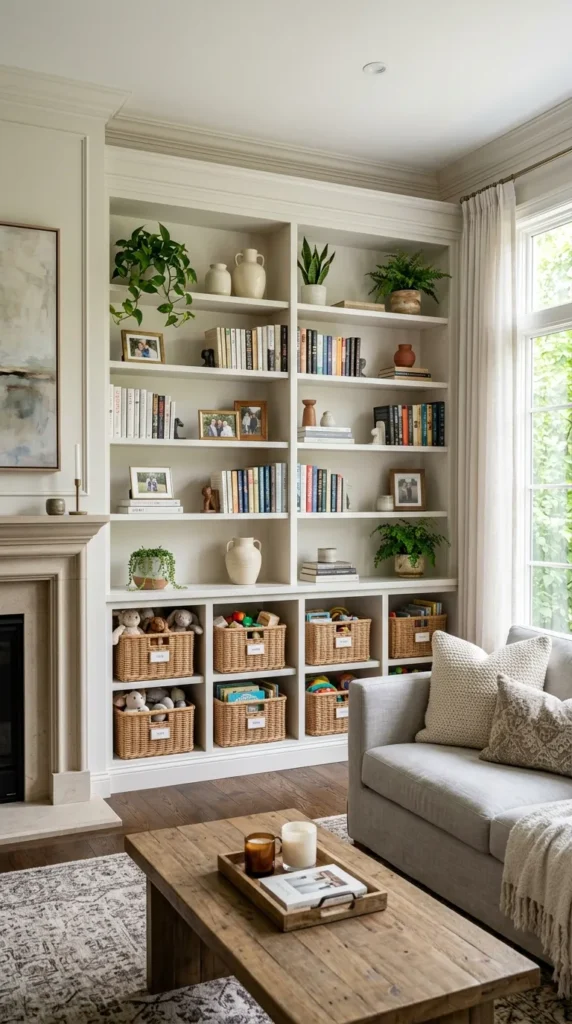
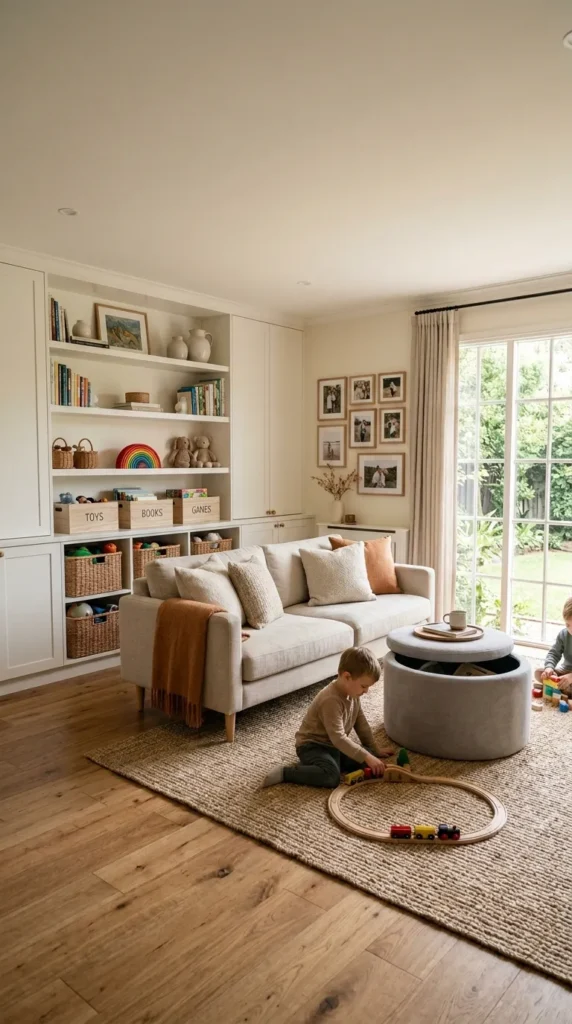
Built-in shelving floor-to-ceiling cabinetry with a combination of open shelves and closed cupboards designed and installed specifically for the living room is the toy storage solution that transforms a room most completely and most permanently, and that creates the most generous, most organized, and most visually integrated storage available to a family living room. The design that works best for families with young children combines lower-level closed cupboards at child height, accessible to small hands, concealing the toys and games that are used most frequently and that create the most visual clutter when left out with upper-level open shelving for books, plants, artwork, and decorative objects that benefit from being displayed rather than concealed. This division closed below for children’s practical use, open above for adult decorative display creates a wall of storage that functions perfectly for every member of the family and looks, from across the room, like a designed architectural feature rather than a storage solution.
The investment that built-in shelving requires both financial and in terms of commitment to a specific configuration is justified by the transformation it creates in a living room that has struggled with toy storage through other means. A living room with generous built-in storage simply functions better than one without it, because every category of object in the room has a designated home and can be returned to that home quickly and without decision-making. Fill the lower cupboards with labeled baskets one for Lego, one for art supplies, one for board games, one for soft toys so that children can locate and return specific items independently without parental involvement. Use the open shelves above for books arranged by color or size, for plants in coordinating ceramic pots, and for the handful of genuinely beautiful objects that deserve to be seen, and the built-in will look as considered as it is practical.
Want a space that’s both organized and stylish? Explore 15 Built-In Living Room Shelves for Style for beautiful storage and display inspiration.
4. A Bench With Hidden Storage at the Room’s Edge
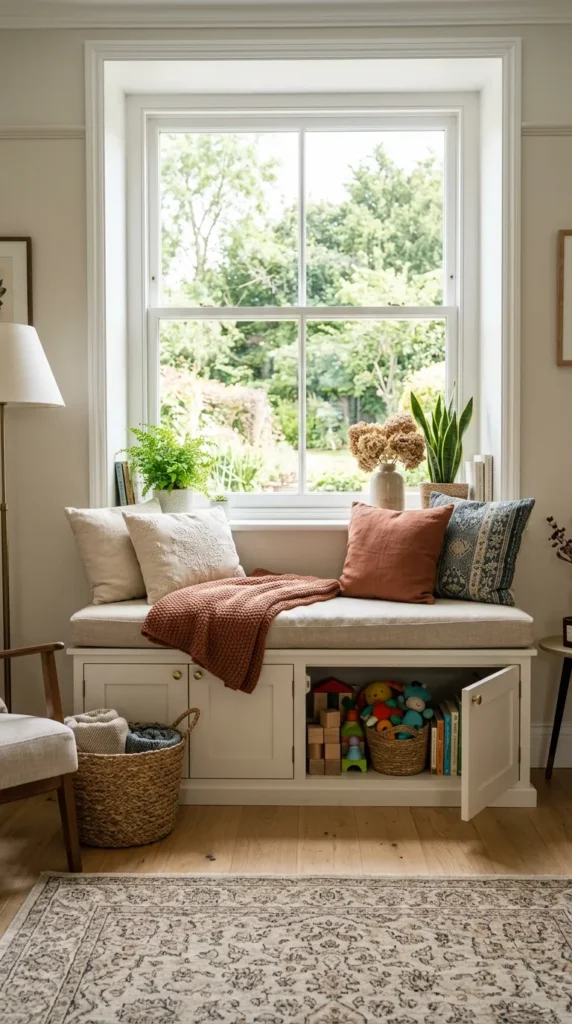
A storage bench a long, upholstered or timber bench with a hinged seat that opens to reveal a deep storage compartment beneath positioned along one wall of the living room or at the back of a sofa creates a piece of furniture that earns its floor space several times over. As a piece of furniture, it provides casual seating for additional guests, a surface for bags and belongings at the entry side of the room, and a visual anchor for a wall that might otherwise feel bare and purposeless. As storage, it provides a long, deep compartment that swallows bulky toys building blocks, ride-on toys that have been retired but not yet discarded, large soft toys, sports equipment that migrates indoors that defeat smaller storage solutions entirely. The combination of these functions in a single piece makes the storage bench one of the most space-efficient furniture investments available to a living room that needs both seating flexibility and generous toy storage simultaneously.
The design of a storage bench for a living room should be chosen with the same care as any upholstered furniture piece, because it occupies a significant visual presence in the room and will be seen from most positions within it. A timber bench with a cushioned top suits living rooms with natural material palettes and creates a warm, organic presence at the room’s edge. An upholstered bench in a performance fabric suits more contemporary living rooms and allows the piece to coordinate with the sofa and armchairs through fabric selection. A painted timber bench in a color that references the room’s accent palette a deep sage green, a warm navy, a soft terracotta creates a piece that contributes to the room’s color story rather than merely occupying space within it. Fit the storage compartment with a simple lining in a coordinating fabric to make the interior feel considered and to protect toys from splinters or rough timber surfaces.
5. A Low Sideboard With Deep Drawers for Organized Storage
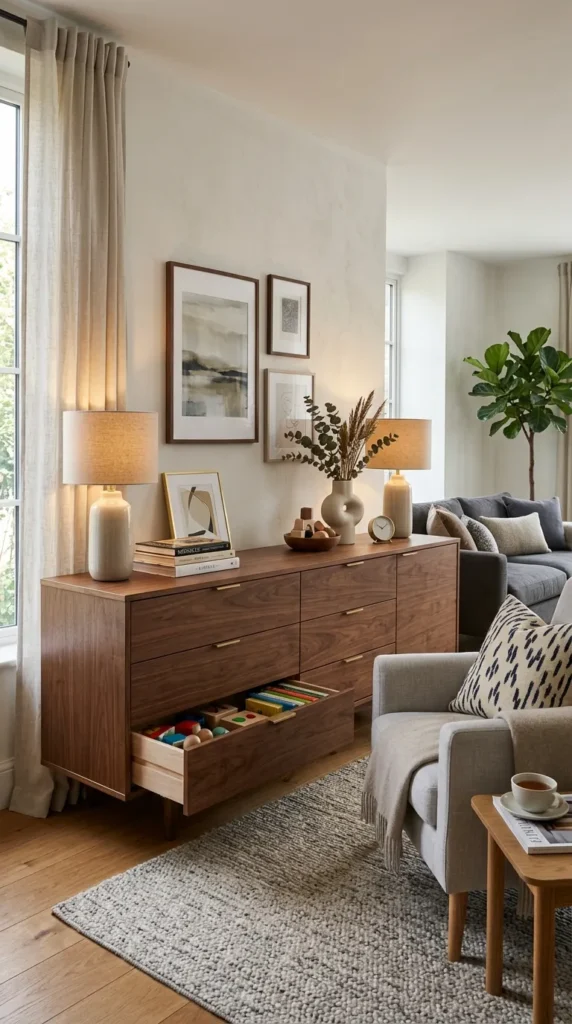
The sideboard a long, low piece of case furniture with drawers, cupboards, or a combination of both is traditionally a dining room piece, but its proportions and storage configuration make it one of the most useful and most visually appropriate toy storage solutions available to a living room. A well-chosen sideboard sits low enough that its surface becomes a display area for lamps, plants, and artwork rather than an elevated unit that dominates the room, and its interior whether drawers, cupboards, or both provides organized, concealed storage for toys, games, craft supplies, and the accumulated accessories of family life that resist tidier categorization. The surface of a sideboard in a living room with young children also serves a practical function beyond decoration: it creates a surface at adult height that is above the reach of toddlers and young children, providing a protected space for remote controls, adult books, and the objects that need to be accessible to adults but inaccessible to small hands.
The choice between drawers and cupboards in a toy storage sideboard depends on the age of the children using it and the nature of the toys being stored. Deep drawers suit smaller toys Lego, art supplies, small figures, puzzles with their pieces contained in zip-lock bags that benefit from the organizational clarity of separate drawer spaces and that can be laid flat without stacking. Cupboards suit bulkier items board games in their boxes, large construction sets, soft toys that cannot be laid flat and that need the vertical space that a cupboard’s interior provides. A sideboard that combines both two or three drawers on one side, two cupboard doors on the other typically serves a family living room most completely and most flexibly as the children’s ages and the nature of their toys changes over time.
6. Fabric Cube Storage Ottomans in a Grid Formation
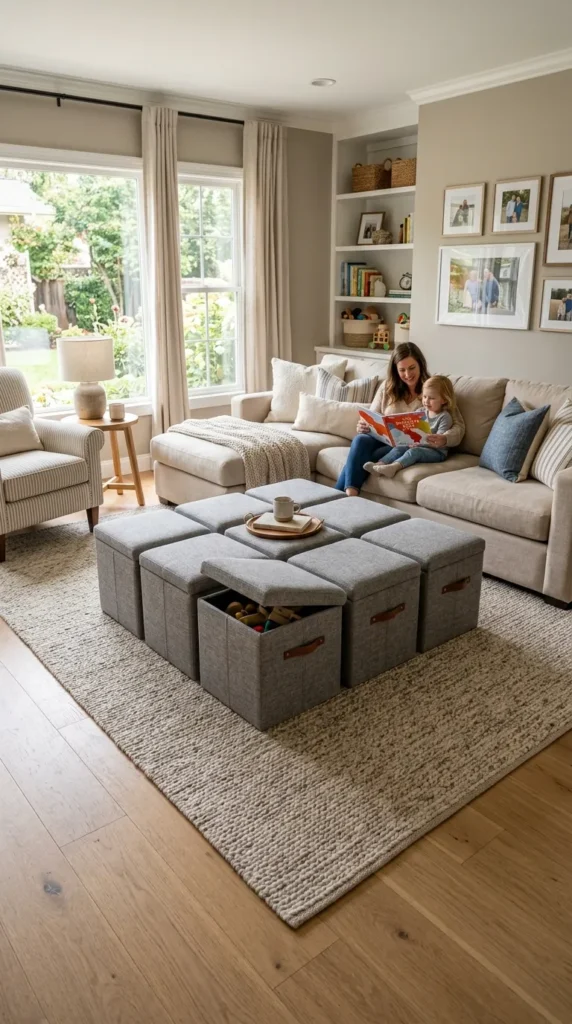
Fabric cube storage ottomans the soft, square storage boxes that are simultaneously a seat, a footrest, and a toy container arranged in a simple grid formation create a toy storage system that is as flexible and reconfigurable as any fixed furniture solution but can be rearranged, added to, or removed entirely as the family’s needs change. Each cube provides its own contained storage space, and a grid of four two by two creates a low-level storage and seating arrangement that can be pushed together to form a large ottoman surface, separated to create individual seats around the room, or pushed aside entirely to create floor space for play. This flexibility is particularly valuable in living rooms that need to function differently at different times as a family play space in the afternoon, as an adult entertaining space in the evening because the cubes can be quickly rearranged and their lids closed to transform the room’s character with minimal effort and without moving heavy furniture.
Choose fabric cube ottomans in a color and material that coordinates with the living room’s existing palette rather than in the primary-color combinations that many children’s versions are offered in, which suit a dedicated playroom but look out of place in a living room that also serves adult purposes. Neutral linen, warm grey performance fabric, or a simple textured weave in a tone that references the sofa or the rug will allow the cubes to read as a designed element of the living room rather than children’s furniture that has been permitted into an adult space. Label each cube simply with a small tag or a chalk label on the inside of the lid so that children can identify which cube contains which category of toy and return items to the correct cube independently, which is the habit that keeps the system functioning rather than descending into a situation where every cube contains an undifferentiated mixture of everything.
7. A Bookshelf Dedicated Partly to Toys and Partly to Books
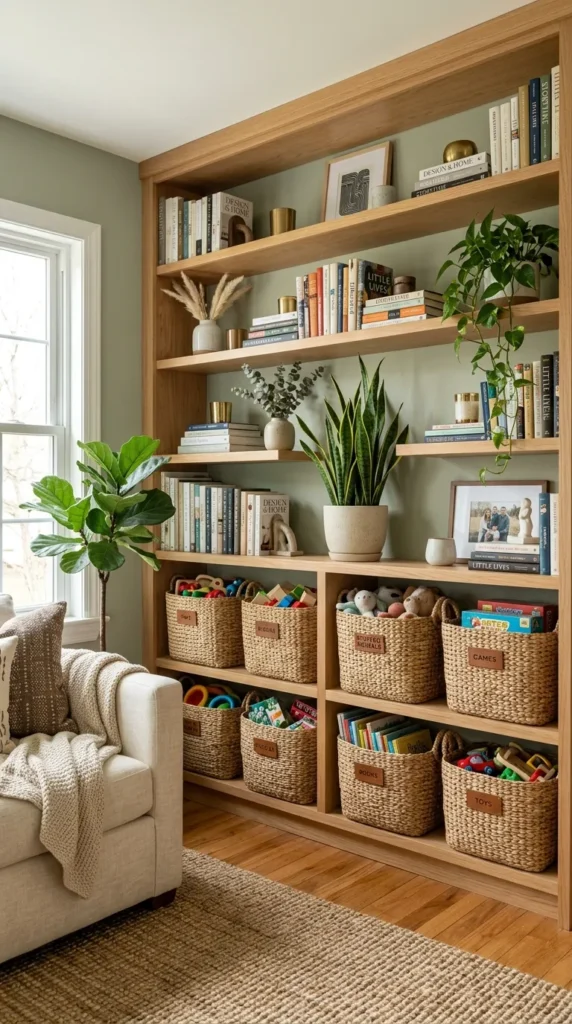
In a living room that already has a bookshelf or in one where a bookshelf would be a natural and welcome addition dedicating a portion of the shelf space specifically to toys creates an integrated storage solution that requires no additional furniture and no additional floor space. The most effective approach is to reserve the lower two or three shelves of the bookshelf for toys either placed directly on the shelves in an organized arrangement or contained in attractive baskets or boxes that slide onto the shelves and conceal their contents while using the upper shelves for books, plants, and decorative objects in the conventional manner. The result is a bookshelf that functions fully for both adults and children simultaneously, with each group’s materials at the height most accessible to them and the overall visual impression from across the room of a considered, well-organized display rather than a compromise between storage functions.
The toy containers chosen for the lower shelves of a shared bookshelf deserve as much design attention as the objects on the upper shelves, because they occupy the most visible portion of the shelf at eye level when seated and contribute significantly to the overall visual character of the piece. Woven seagrass boxes, painted timber crates in coordinating colors, fabric bins in a neutral linen, or simple white storage boxes with handwritten labels all work well and suit different living room aesthetics. Avoid plastic bins in primary colors on this shelf, which will read as playroom storage rather than living room storage and undermine the integration that makes this approach work. The goal is a lower shelf that reads as organized and considered even when you know it contains Duplo and Play-Doh, and the right container choice makes this entirely achievable.
8. A Toy Kitchen or Play Unit Designed to Look Like Adult Furniture
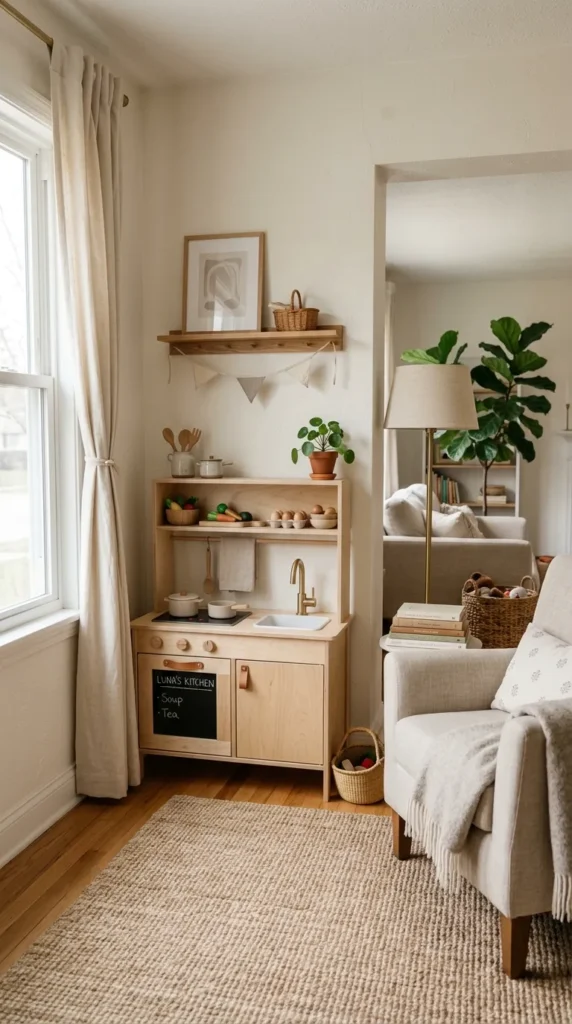
For families with young children whose imaginative play centers on role play and domestic scenarios kitchens, shops, workbenches a play unit designed to look like adult furniture rather than obviously children’s equipment creates a piece that can sit in a living room without visually announcing itself as a children’s toy from across the room. Play kitchens in neutral colors white, grey, natural timber with simple, clean lines and without the bright primary color schemes that characterize most children’s play equipment look, at a casual glance, like a small piece of furniture rather than a toy. They also tend to be better made than their brightly colored equivalents, because the manufacturers who produce them are targeting parents who care about design as well as function and invest in higher quality materials and construction accordingly. A well-designed neutral play kitchen in the corner of a living room is a concession to the reality of family life, but it is a graceful concession that maintains the room’s design dignity rather than sacrificing it entirely.
The positioning of a play kitchen or play unit in the living room matters almost as much as its design. A corner placement where two walls meet minimizes the unit’s visual footprint and prevents it from dominating the room’s center. Placing it beside or adjacent to the family’s actual kitchen, if the living room opens onto a kitchen, creates a logical and visually coherent juxtaposition that children find satisfying and that adults can read as intentional rather than incidental. Surround the play unit with a small rug in a coordinating color to define its territory within the living room and create a visual container for the play area that prevents it from bleeding into the rest of the room. When the children outgrow the unit, its neutral design and solid construction means it can be repurposed as storage, passed to another family, or sold without the significant depreciation that brightly colored plastic equipment typically suffers.
9. Wall-Mounted Rail Storage for Art Supplies and Smaller Toys
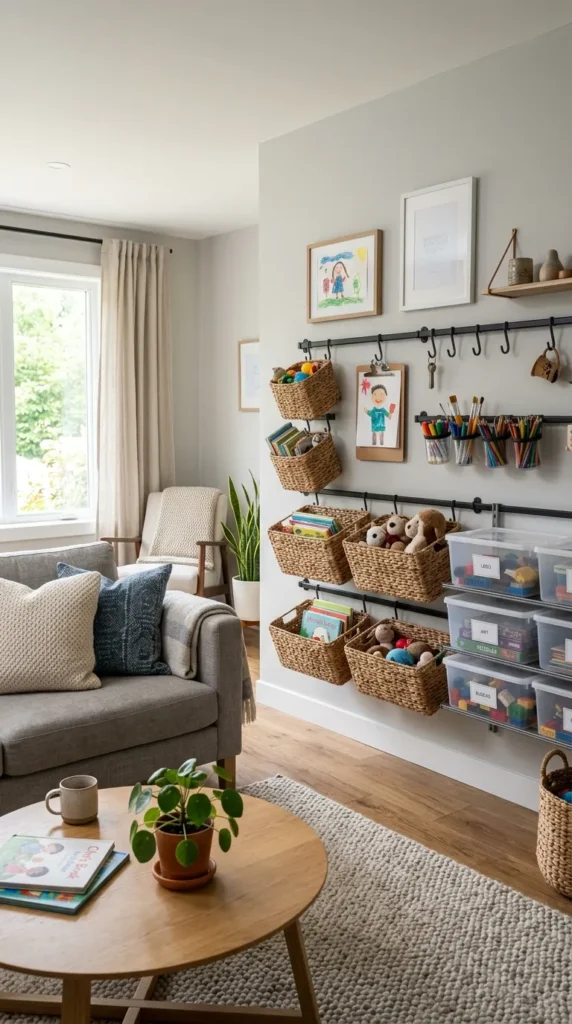
A wall-mounted storage rail a horizontal rail fixed to the wall with hanging baskets, hooks, and containers suspended from it creates vertical toy storage that uses wall space rather than floor space, which is the most valuable trade in any living room where floor space is limited and every square meter of it needs to justify its occupation. Originally designed for kitchen storage, the rail system adapts beautifully to living room toy storage when chosen in a finish and style that suits the room’s aesthetic a matte black rail with simple wire baskets suits an industrial or contemporary living room, a brass rail with woven baskets suits a warmer, more natural aesthetic, and a white powder-coated rail with clean white containers suits a minimal or Scandinavian-influenced space. The rail’s contents art supplies, small toys organized by category, craft materials are visible and accessible to children without requiring floor-level searching, and the system can be reconfigured, expanded, or reduced as the family’s storage needs change simply by adding or removing hanging components.
The wall that hosts a storage rail in a living room benefits from being a dedicated storage wall a wall that is committed to function and organized attractively enough that its functional purpose reads as designed rather than improvised. Pair the rail with a low bench beneath it, creating a surface for art and craft activities, and with a simple shelf above it for plants or artwork, to create a wall composition that is organized and visually complete from ceiling to floor. Children respond to organized, accessible storage that is clearly theirs a dedicated storage wall in the living room communicates that their activities are valued and accommodated in the family’s space, which reduces the resistance to tidying that arises when children feel their things are tolerated rather than welcomed in the family’s shared environment.
10. A Repurposed Vintage Trunk or Chest
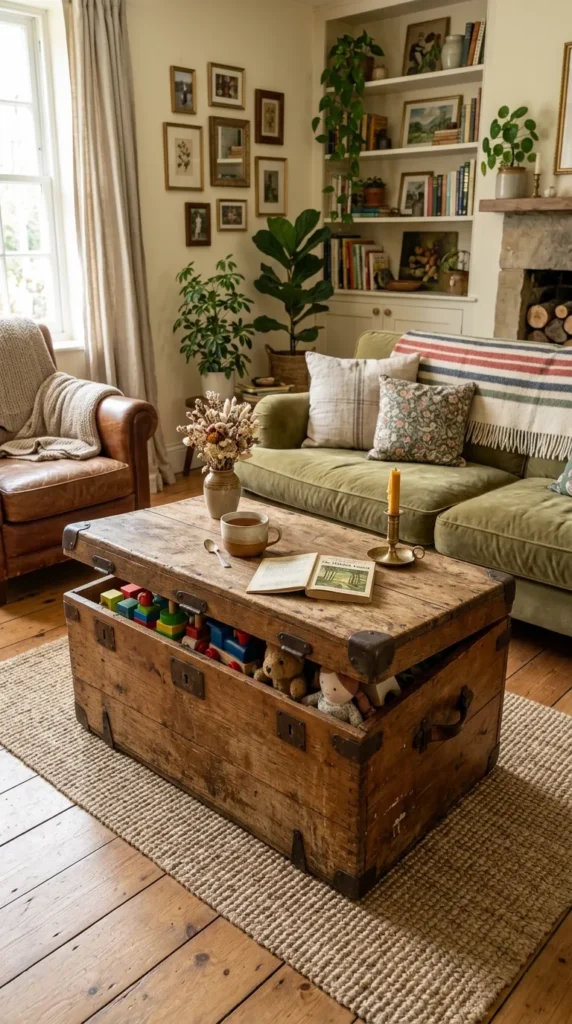
A vintage trunk or blanket chest the kind found in junk shops, antique markets, and the spare rooms of older relatives is one of the most characterful and most generous toy storage solutions available to a living room, and its second-hand origin means it arrives with the patina and personality that new furniture spends decades trying to earn. A large vintage trunk positioned at the foot of a sofa, in front of a fireplace, or against a wall provides a cavernous interior that swallows an extraordinary volume of toys, a surface that serves as a coffee table or display area, and a design element of genuine character that contributes warmth and history to a living room in a way that purpose-made furniture rarely achieves. The worn leather handles, the slightly battered corners, the faded paint or aged timber of a vintage trunk these qualities read as beautiful in a living room that values character over perfection, and they age further and more gracefully with continued family use rather than deteriorating.
The practical consideration with vintage trunks as toy storage is the lid heavy lids on older trunks can be hazardous for young children if they fall closed unexpectedly, and fitting a simple soft-close hinge mechanism or a lid support that prevents the lid from falling beyond a certain angle is a straightforward modification that makes the piece genuinely safe for family use. Line the interior with a simple fabric a piece of canvas, a cotton drop cloth, a remnant of upholstery fabric in a coordinating tone to protect toys from rough timber or metal interiors and to make the chest more pleasant to use. A vintage trunk that has been lightly restored cleaned, the hinges oiled, the interior lined and positioned thoughtfully in the living room will be the piece that every guest asks about first, which is a quality that purpose-built toy storage almost never achieves.
11. Stackable Timber Crates for Flexible Organization
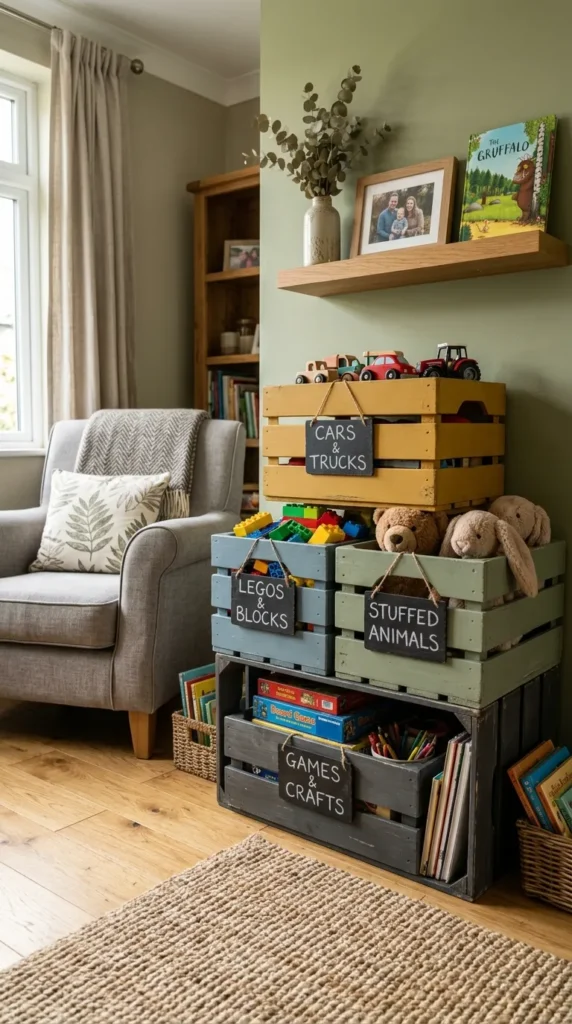
Stackable timber crates the simple, open-sided wooden boxes originally designed for fruit and vegetable markets have become one of the most versatile and most popular DIY storage solutions available to family living rooms, precisely because their simplicity allows them to be configured, painted, combined, and adapted in an almost unlimited number of ways to suit specific room sizes, specific storage requirements, and specific aesthetic preferences. A stack of three or four timber crates against a wall, each dedicated to a different category of toy, creates a storage unit that is open enough for children to see and access its contents instantly, organized enough that specific toys can be located and returned without searching through a mixed container, and visually warm enough natural timber, simple construction, visible wood grain to suit most living room aesthetics without requiring the room to surrender its adult character. The stacking configuration can be changed as the children’s ages and toy categories change, additional crates can be added as the collection grows, and the entire system can be disassembled and repurposed when toy storage is no longer needed.
Paint or stain timber crates to coordinate with the living room’s palette for a result that looks more finished and more intentional than raw timber, which can read as temporary or unresolved in a designed space. A deep sage green, a warm white, a matte charcoal, or a warm terracotta applied to the exterior of the crates while leaving the interior natural timber creates a piece that contributes color and character to the room while maintaining the warmth of natural wood on the surfaces that children handle. Label each crate simply and clearly with a hand-painted label, a chalkboard panel, or a simple hanging tag so that the organizational system is legible to children independently and does not require adult translation. A stack of well-painted, clearly labeled timber crates in a corner of a living room looks like a deliberate design choice rather than an improvised storage solution, which is the quality that all successful living room toy storage shares.
12. A Reading Nook With Built-In Toy Storage Beneath
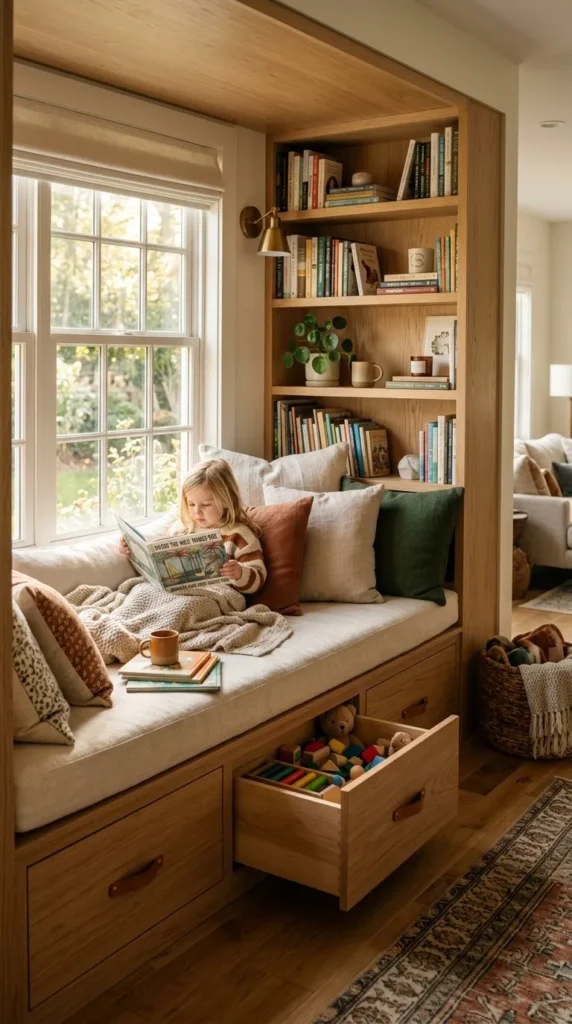
A reading nook a defined, enclosed area within the living room that creates a semi-private space for a child to read, play quietly, or retreat from the larger social activity of the family room is one of the most beloved additions to a family living room, and when it is designed with built-in storage beneath the seating, it combines two of the most valuable things a family living room can contain: a dedicated space for children that is theirs within the shared room, and generous, concealed toy storage that is integrated into the architecture rather than added as a furniture afterthought. The built-in bench of a reading nook, with drawers or lift-up seat storage beneath it, provides the most seamlessly integrated toy storage available it occupies space that would otherwise be dead volume beneath the seat, requires no additional floor area, and looks from every angle like a designed architectural feature rather than a storage solution. Children who have a reading nook with their own storage within it tend to keep it more organized than children whose toys are stored in shared, general-purpose containers, because the space feels personal and its organization feels like an extension of personal pride rather than a household obligation.
The design of a reading nook with integrated storage in a living room benefits from being genuinely enclosed on at least two sides built into an alcove, positioned in a corner with a low bookshelf forming the open side, or defined by a change in ceiling height if the architecture permits so that the child within it has a genuine sense of being in a defined space rather than simply sitting in a corner of the larger room. Cushion the seat generously in a performance fabric that coordinates with the living room’s upholstery palette, line the back wall with shelving for books and small toys, and paint the interior in a slightly deeper or warmer tone than the surrounding room to create a sense of warmth and enclosure that makes the nook feel genuinely special. The storage beneath the seat accessed by lift-up cushions or pull-out drawers should be organized with the same labeled basket system used elsewhere in the room for organizational consistency that children can follow independently.
Create a warm and inviting family room with ideas from 14 Brown Couch Living Room Ideas for cozy seating and timeless décor inspiration.
13. A Low Trolley or Cart That Rolls Away When Not in Use
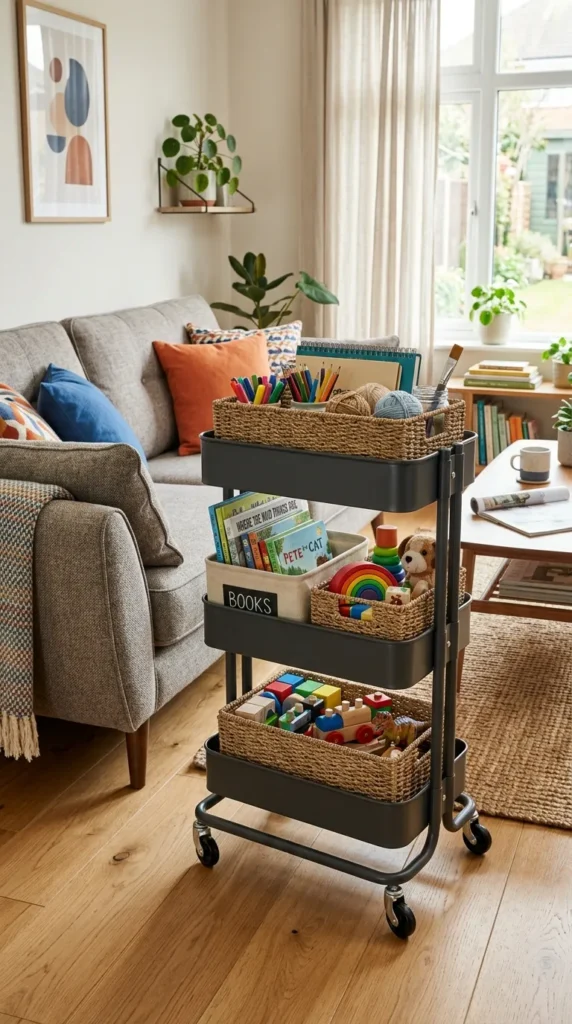
A rolling storage trolley a small cart on wheels with shelves, drawers, or a combination of both is the toy storage solution for living rooms where flexibility is the primary requirement and where the storage needs to disappear entirely when the living room needs to function as a child-free adult space. A well-chosen trolley sits beside the sofa or in a corner during family time, providing easy access to toys, art supplies, or craft materials at children’s height without requiring any fixed furniture installation. When guests arrive, when the room needs to function differently, or simply when the family wants the living room to feel like an adult space for an evening, the trolley rolls into a hallway cupboard, into a bedroom, or into any space with sufficient clearance to receive it, taking the entire toy collection with it and returning the living room to its unencumbered form in under thirty seconds. No other toy storage solution offers this combination of immediate accessibility during use and complete removal when not needed.
The trolley that works best as a living room toy storage solution is one that is proportioned and finished to suit the room’s aesthetic rather than one designed primarily for utility. Kitchen trolleys in timber and brass, bar carts in matte black steel, and library trolleys in painted timber all translate naturally into toy storage in a living room while looking more considered and more designed than purpose-made children’s storage trolleys, which tend toward primary colors and plastic construction that suits a dedicated playroom rather than a shared family living room. Choose a trolley whose shelves are open rather than enclosed so that children can see and access its contents immediately without opening drawers or lifting lids the lower the friction involved in getting toys out and putting them away, the more consistently the storage system will be used by children of all ages. Add a simple basket or bin on each shelf to contain loose items and prevent small toys from falling through open shelf surfaces.
14. Pegboard Wall Storage for Display and Organization
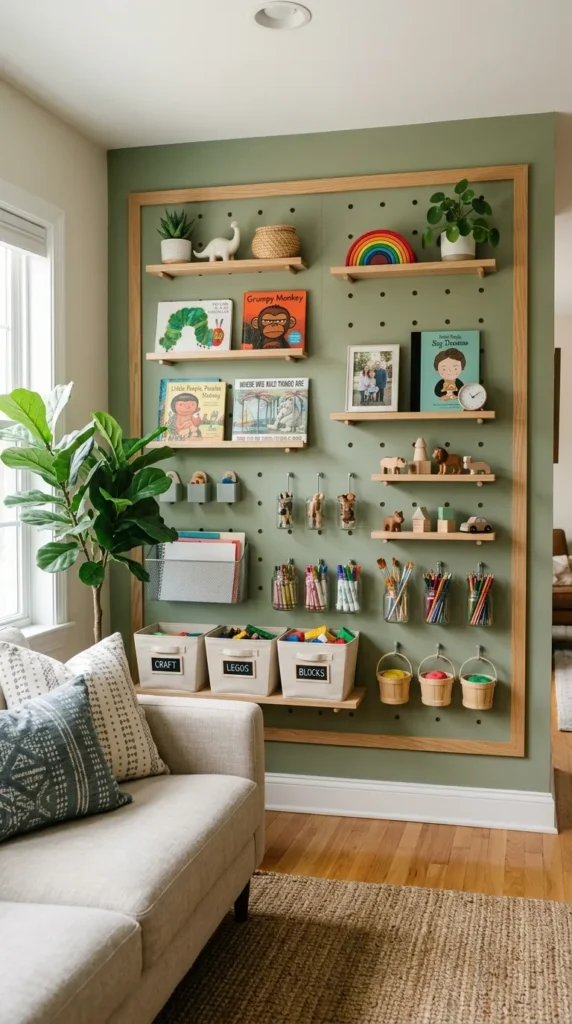
A pegboard a sheet of perforated board mounted on a wall, fitted with hooks, shelves, and containers that slot into the perforations creates a wall-mounted storage and display system of extraordinary flexibility that suits living rooms where toy storage needs to be both accessible and visually interesting. Originally an industrial storage solution, pegboard has been adopted enthusiastically by interior designers and family home decorators because its flexibility is genuinely unmatched every hook, shelf, and container can be repositioned within minutes as storage needs change, and the overall system can be expanded simply by adding a larger or additional board. In a living room, a pegboard section of wall framed neatly and painted in a coordinating color so that it reads as a designed wall feature rather than a functional installation can hold art supplies in jars, small toys on hooks, books on small ledges, and the daily-use items that otherwise migrate to every horizontal surface in the room. Children engage with pegboard storage actively because they can see everything it contains at a glance, which reduces the searching and the resulting chaos that hidden storage sometimes creates.
The aesthetic success of a pegboard in a living room depends almost entirely on how it is framed, finished, and curated. A raw, unframed pegboard mounted directly on a wall looks utilitarian regardless of what is displayed on it. A pegboard painted in the same color as the wall it is mounted on, or in a contrasting accent color that relates to the room’s palette, and framed with a simple timber border that gives it the visual definition of a picture or a panel, looks like a designed wall feature that happens to be functional. Curate what is displayed on it with genuine editorial care limit the contents to the toys and supplies that are genuinely used daily, organize them visually so that similar items are grouped and heights vary pleasingly, and incorporate one or two purely decorative elements a small plant, a framed print, a beautiful ceramic jar so that the pegboard reads as a display as well as a storage system and maintains its visual quality even when it is fully loaded.
15. A Dedicated Toy Zone Defined by a Rug and Open Storage
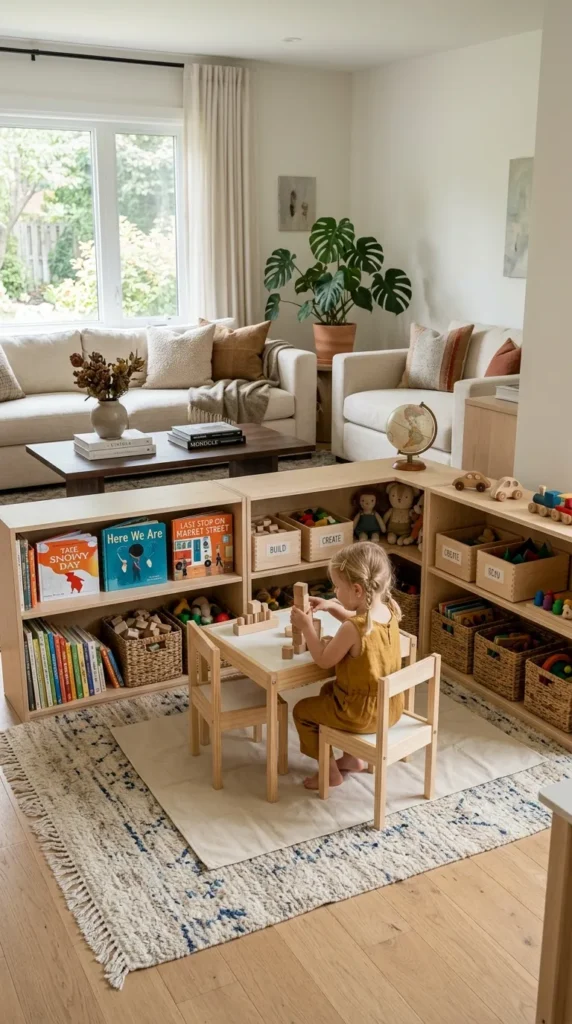
The most honest and most practical approach to toy storage in a living room is sometimes not to conceal the toys at all, but to define their territory so clearly and organize their storage so attractively that the presence of toys in the living room reads as a deliberate, considered design choice rather than evidence of domestic entropy. A dedicated toy zone a defined area of the living room marked by a rug in a coordinating color, with low open shelving or a combination of attractive open bins arranged around its perimeter creates a children’s area within the family space that is organized, accessible, and visually contained rather than spreading across the entire room in the undifferentiated way that toy chaos tends to. The rug defines the boundary: toys live on the rug and on the storage around it, and the rest of the living room remains clear. Children understand this boundary surprisingly quickly and maintain it more consistently than adults expect, because the definition it provides actually helps them feel oriented within the shared space rather than overwhelmed by it.
The storage within the toy zone should prioritize visibility and accessibility over concealment, because the purpose of this approach is honest accommodation of children’s materials rather than hiding them. Low open shelving with individual baskets or bins for each toy category clearly labeled with pictures for pre-readers allows children to locate and return specific items entirely independently, which is the habit that keeps the zone organized rather than allowing it to collapse into a general pile. Choose storage containers in colors and materials that coordinate with the living room’s palette natural seagrass baskets, neutral linen bins, painted timber crates in a coordinating accent color so that the toy zone, even when fully loaded with toys, reads as a designed element of the living room rather than an intrusion into it. A small string of lights above the shelving, a plant on the top shelf, and a piece of the child’s own artwork framed on the wall above the zone transforms utilitarian storage into something that feels genuinely special and genuinely theirs within the family’s shared home.
Creating a Toy Storage System That Actually Stays Organized
The toy storage system that stays organized over time is not the most beautiful one or the most expensive one it is the one that is genuinely easy enough for the children who use it to maintain independently without adult supervision or intervention for every item. This principle sounds obvious but is violated by almost every toy storage solution that prioritizes adult aesthetics over child usability, and the result is always the same: the storage system looks beautiful for the first week after it is established, then gradually deteriorates into the same chaos it was designed to replace, because the people who use it most frequently the children find it too difficult, too confusing, or too time-consuming to use consistently. Every friction point in a toy storage system a lid that is too heavy, a label that is unreadable to a pre-reader, a basket that is too high to reach, a category division that is too fine-grained to maintain is a point at which the system will fail and the toys will end up on the floor instead.
Design your toy storage system around the least capable user who will be expected to maintain it independently, which in most families means the youngest child old enough to tidy up. If that child is three, the storage needs lids that a three-year-old can manage, heights that a three-year-old can reach, and categories that are broad enough that a three-year-old can sort accurately without adult guidance probably no more than four or five categories total, identified by pictures as well as words. Build the system in stages rather than all at once, starting with the two or three categories of toy that create the most chaos when unsorted and adding organizational refinement as the children demonstrate the ability to maintain it. A toy storage system that is used imperfectly by children who are genuinely trying to use it is infinitely more valuable than a perfect system that is too difficult to use and therefore abandoned within a fortnight of its installation.