18 Living Room Curtain Ideas to Transform Your Space
Windows are among the most important architectural features in any living room, and yet the curtains that dress them are frequently chosen as an afterthought something to provide privacy and block light rather than a considered design element that contributes meaningfully to the room’s character and atmosphere. This is a significant missed opportunity. Curtains are among the most powerful design tools available to any homeowner: they frame your windows and your views, they introduce color, pattern, and texture at a scale that rivals any piece of furniture, they control the quality of light entering your space, and they add the softness and movement that hard surfaces like walls, floors, and furniture simply cannot provide. The difference between a living room with poorly chosen curtains and one with beautifully designed window treatments is as dramatic as the difference between a well-dressed and an underdressed person the bones may be the same, but the impression is entirely different. Whether you prefer the drama of floor-to-ceiling silk panels, the casual warmth of linen sheers, the graphic impact of bold pattern, or the quiet sophistication of textured neutrals, these 18 curtain ideas for living rooms will inspire you to treat your windows with the design seriousness they deserve.
1. Floor-to-Ceiling Curtains That Maximize Height and Drama
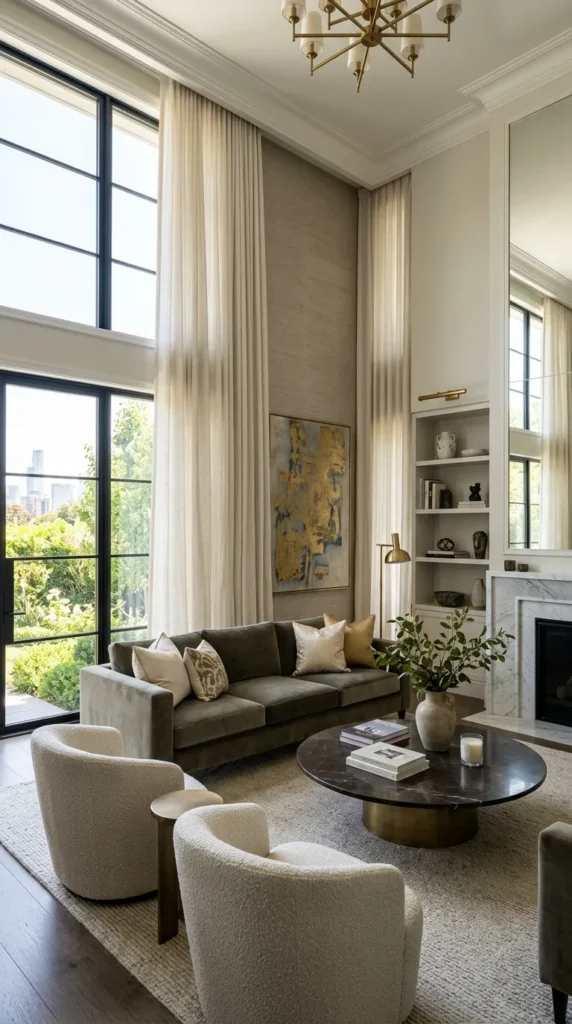
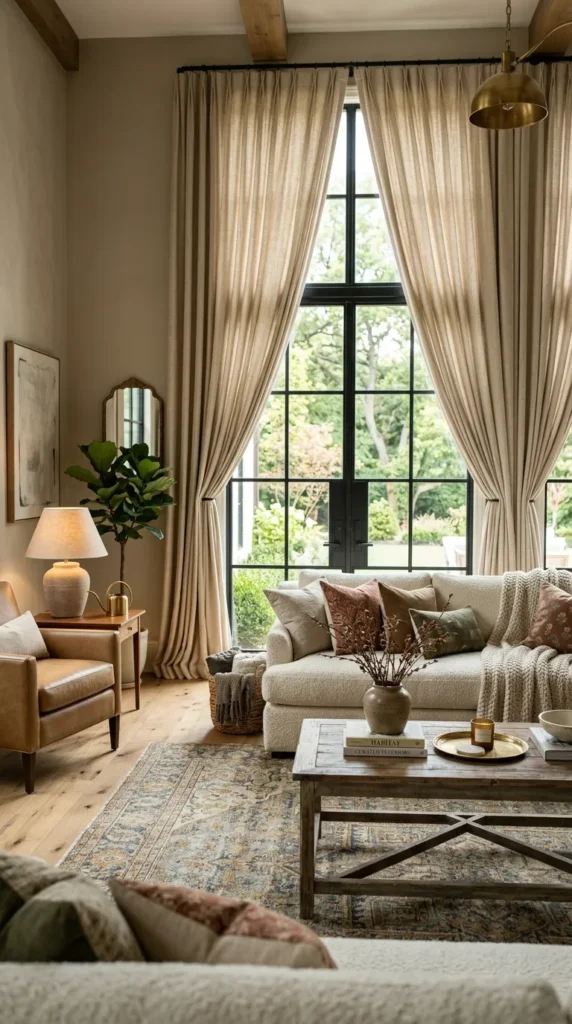
Floor-to-ceiling curtains panels that hang from the very highest point of the wall, just below the ceiling cornice, and fall all the way to the floor are the single most effective curtain technique for making any living room feel taller, grander, and more luxurious. The unbroken vertical line from ceiling to floor draws the eye upward and creates a powerful sense of height that even genuinely high-ceilinged rooms benefit from. In rooms with standard eight or nine foot ceilings, floor-to-ceiling curtains are virtually transformative they create the impression of a much taller, more architectural space than actually exists.
The technique is simple but must be executed correctly to achieve its full effect. Mount your curtain track or pole as close to the ceiling as possible ideally within two to three inches of the cornice or ceiling line. Choose curtains that are long enough to reach the floor with a slight break of one to two inches, or for maximum drama, allow an additional four to six inches of fabric to pool on the floor. The pooling of fabric at the base of floor-length curtains adds a romantic, theatrical quality that feels genuinely luxurious. Choose fabric with sufficient weight to hang in clean, vertical folds linen, velvet, interlined cotton, and silk all perform beautifully in this role. Lightweight fabrics lack the body to hang with the clean drama that makes floor-to-ceiling curtains so effective.
2. Linen Curtains for Organic, Casual Elegance
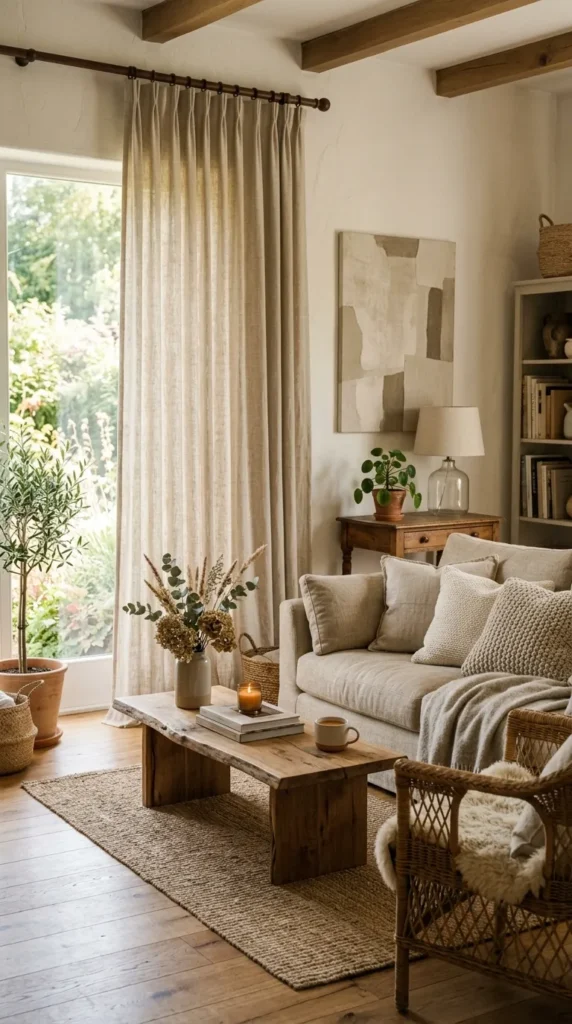
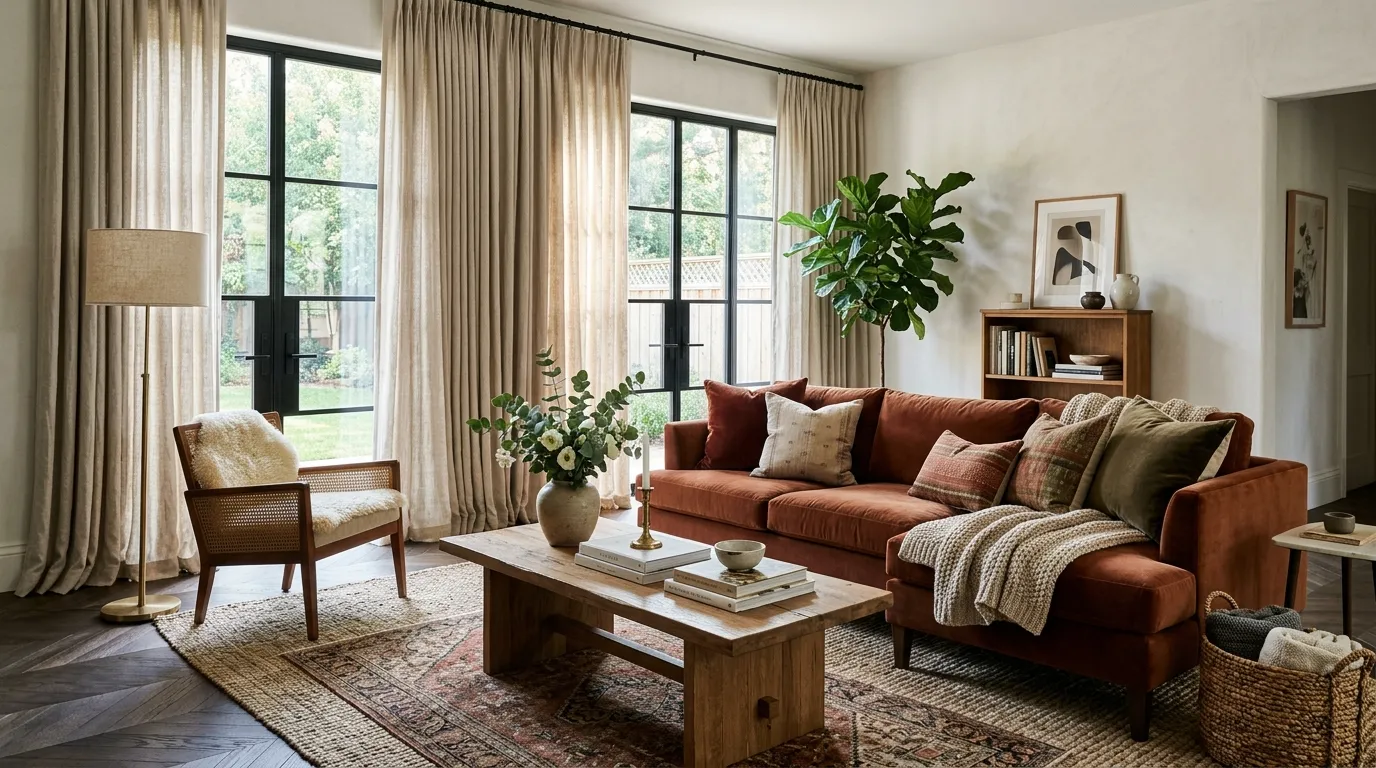
Linen curtains bring a quality of organic, unpretentious elegance to living rooms that no synthetic fabric can replicate. The natural fiber has a beautiful texture slightly irregular, with a subtle slub that catches light differently across its surface and a characteristic way of hanging that is neither stiff nor fluid but somewhere beautifully in between. Linen curtains in natural, undyed tones warm ivory, oatmeal, flax, natural greige coordinate with virtually every color palette while adding genuine warmth and texture to the room.
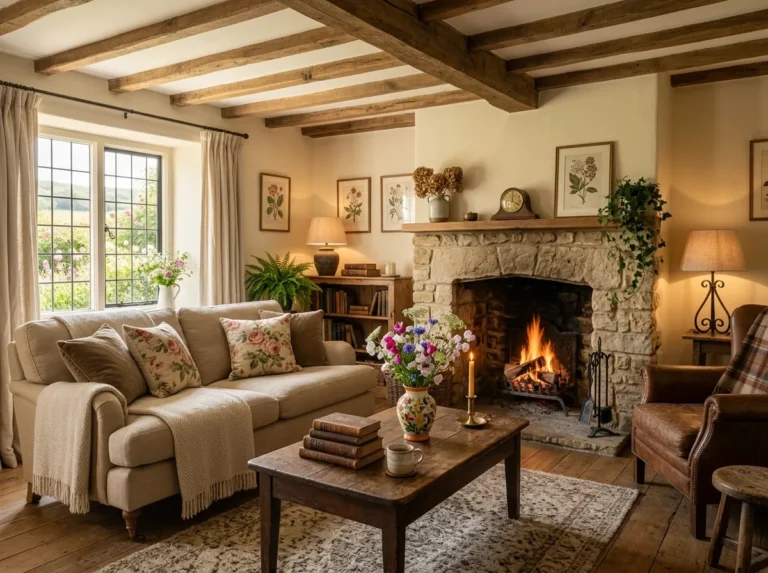
The slight transparency of linen is one of its great virtues in a living room context. Unlined linen curtains allow diffused natural light to filter through while providing daytime privacy, creating a soft, luminous quality in the room that heavier fabrics cannot achieve. For evenings, a separate blackout lining or a secondary set of roller blinds behind linen curtains provides complete privacy without sacrificing the fabric’s beautiful light-filtering quality during the day. Linen curtains wrinkle naturally, and this is entirely appropriate the slight creasing of linen is part of its organic charm rather than a defect to be ironed out. Wash linen curtains regularly to keep them fresh and soft, as linen improves in texture and character with washing over time.
3. Velvet Curtains for Rich, Dramatic Luxury
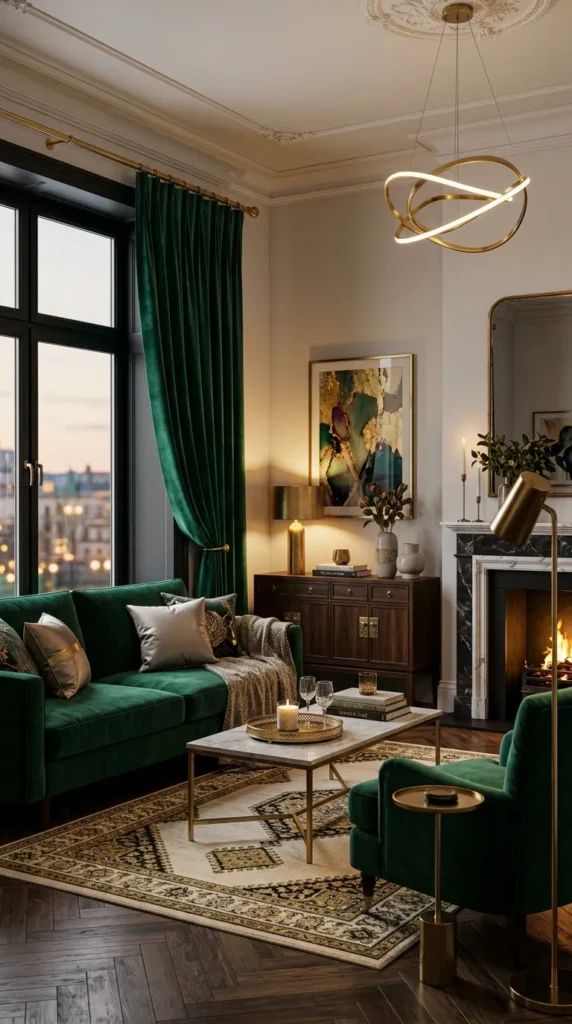
Velvet curtains are the most unambiguously luxurious window treatment available for living rooms. The deep pile of velvet absorbs light rather than reflecting it, creating a depth and richness of color that flat fabrics simply cannot match. Velvet curtains in deep jewel tones forest green, sapphire blue, rich burgundy, deep plum, warm burnt orange transform a window into a statement of genuine color confidence and material sophistication. Even velvet curtains in neutral tones warm charcoal, soft taupe, deep ivory have a sumptuous quality that elevates any room.
Beyond their extraordinary visual impact, velvet curtains are genuinely practical. Their dense pile provides excellent thermal insulation, keeping warmth in during winter and reducing heat gain in summer. They block light extremely effectively, making them ideal for living rooms used for television viewing or afternoon napping. They reduce sound transmission significantly, improving the acoustic quality of the room. Choose velvet curtains with a cotton or silk base rather than synthetic pile for the truest color depth and most beautiful drape. Velvet curtains require careful cleaning professional dry cleaning is recommended for full-length panels to maintain their pile and prevent crushing. Hang velvet curtains on sturdy poles with sufficient brackets, as the fabric is significantly heavier than most alternatives.
4. Sheer Curtains for Soft, Luminous Light
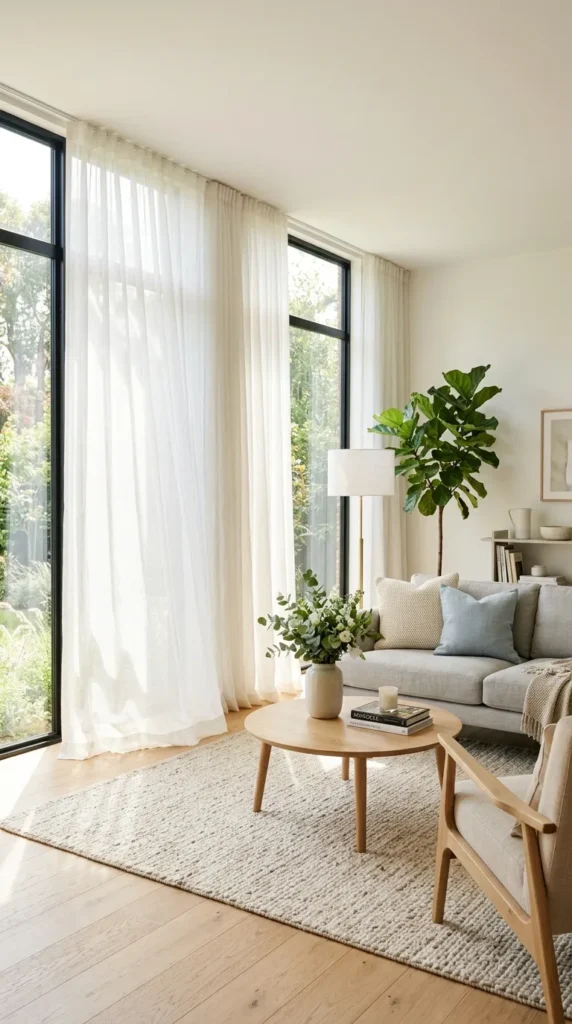
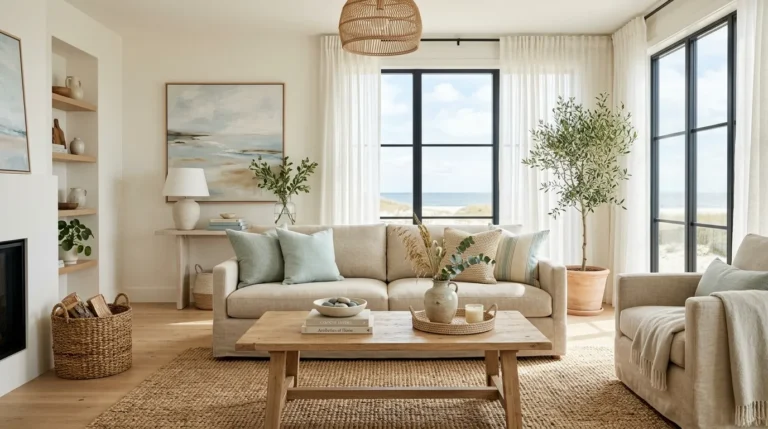
Sheer curtains lightweight, semi-transparent fabrics that filter light while providing daytime privacy create a quality of soft, diffused illumination in living rooms that is unlike any other lighting effect. Where hard window treatments like blinds either admit full direct light or block it entirely, sheer curtains transform direct sunlight into a gentle, luminous glow that fills the room evenly and softly. This quality of light is extraordinarily flattering to both spaces and people, creating an atmosphere of warmth and beauty that is difficult to achieve by any other means.
The most beautiful sheer curtains are those with sufficient fabric fullness to gather into soft, casual folds rather than lying flat against the window. Hang sheers at two to two and a half times the width of the window to achieve generous gathering that creates movement and depth. Choose sheer fabrics in warm white, soft ivory, or barely-there blush rather than stark white, which can look clinical in natural light. Layer sheer curtains with heavier drapes velvet, linen, or patterned fabric panels that can be drawn at night for privacy and warmth. The combination of sheer inner curtains and heavier outer drapes gives you complete control over light, privacy, and atmosphere at every time of day and in every season.
5. Bold Patterned Curtains as the Room’s Statement Element
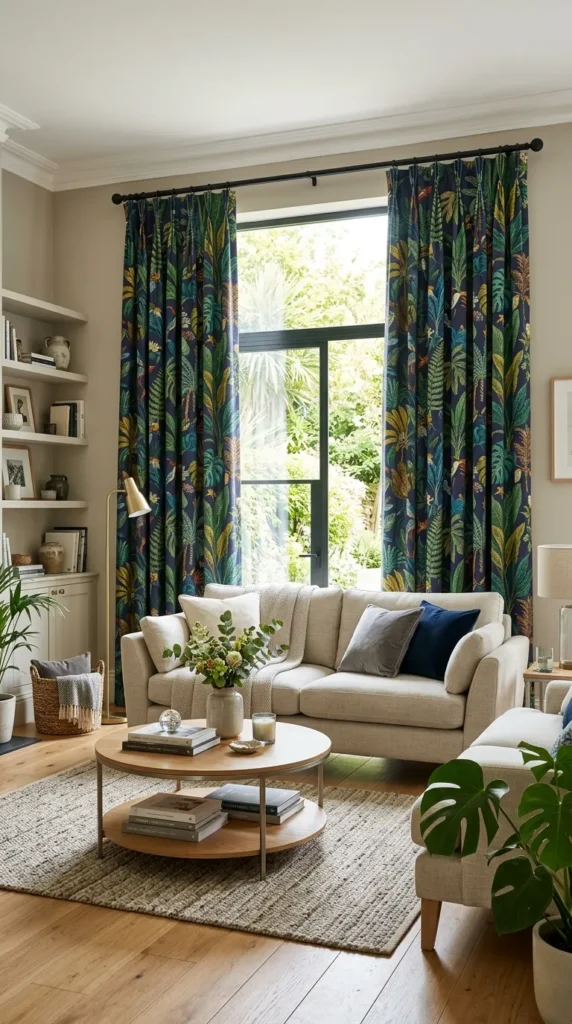
Bold patterned curtains featuring large-scale florals, dramatic geometrics, maximalist botanicals, or abstract designs in strong colors transform windows from architectural openings into genuine design statements. A pair of boldly patterned curtains in a living room with relatively simple furniture and neutral walls creates an instant focal point of tremendous visual energy. The pattern introduces color, movement, and personality at a scale that artwork and accessories cannot match. The window becomes a composition, the curtains a work of decorative art.
The key to using bold patterned curtains successfully is restraint everywhere else. If your curtains feature a complex floral in four or five colors, keep your upholstery in solid tones pulled from the curtain’s palette. Allow the curtains to set the room’s color direction and let everything else respond. Choose one dominant color from the curtain pattern for your sofa, a secondary color for accent chairs and cushions, and let the pattern itself provide all the visual complexity the room needs. Pattern matching at seams is important with large-scale designs invest in sufficient fabric to allow proper repeat matching, as mismatched patterns at seam lines significantly diminish the professional quality of the finished curtain. Choose a reputable maker for patterned curtains, as precise cutting and matching requires genuine skill.
6. Curtains Hung Wide Beyond the Window Frame
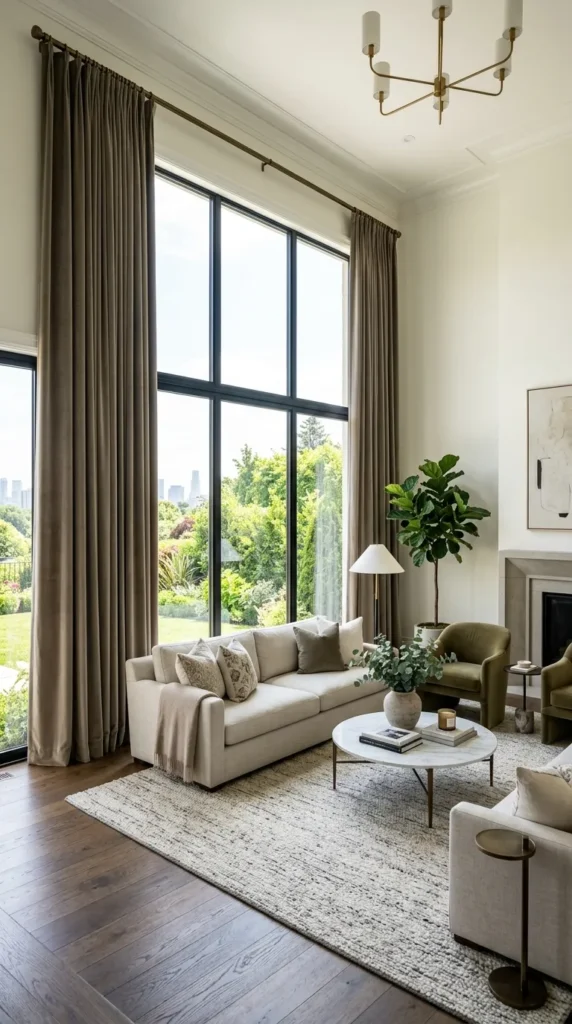
One of the most effective and underused curtain techniques is hanging curtain tracks or poles significantly wider than the window frame itself extending the track 12 to 18 inches beyond the window on each side. When curtains are open, they stack entirely on the wall beside the window rather than overlapping the glass, allowing maximum light to enter. The window appears substantially wider than it actually is. The room feels broader and more generously proportioned. This single technique costs nothing extra and transforms the apparent size of any window.
The wider-than-window hanging technique works with every curtain style and fabric choice. It is particularly effective in rooms where windows are proportionally narrow relative to the wall the extended curtain track visually widens the window to match the wall’s scale. Ensure that the curtain pole or track extends equally on both sides of the window for a balanced, symmetrical appearance. The curtains themselves should be long enough to puddle at the floor or break with a clean edge the generous width and full length together create a window treatment of hotel-like grandeur regardless of the actual window’s size. This technique works especially beautifully with floor-to-ceiling curtains, where the combination of extended width and full height creates an impression of floor-to-ceiling glass across an entire wall.
7. Layered Curtains and Blinds for Versatile Light Control
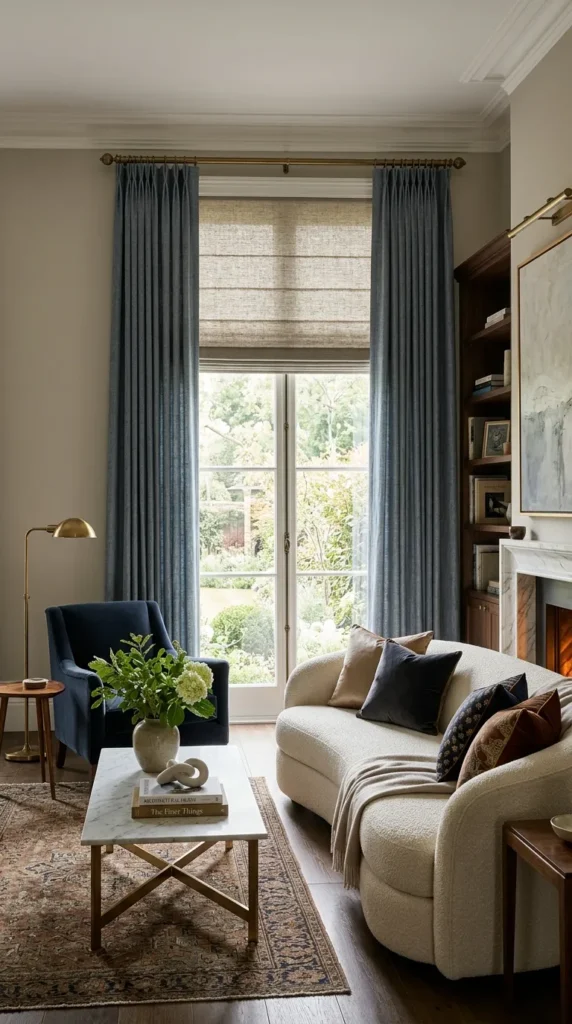
Layering curtains over blinds or combining multiple curtain layers creates the most versatile and sophisticated window treatment possible, allowing complete control over light, privacy, and atmosphere at every time of day. The base layer is typically a Roman blind or roller blind in a fabric that coordinates with the curtains, fitted within the window recess and providing clean, architectural light control. Over this sits the curtain layer full-length panels in a complementary or contrasting fabric that frame the window and soften the room when drawn back.
The layered approach allows genuinely different visual and atmospheric states throughout the day and across seasons. Blind down, curtains open: full privacy with maximum natural light entering through the blind’s fabric. Blind up, curtains drawn: soft, diffused light filtered through curtain fabric with a cozy, enclosed feeling. Blind down, curtains drawn: complete privacy and maximum warmth, ideal for winter evenings. All layers open: maximum light and the full visual impact of the curtain fabric as a framing element. The fabric choices for each layer should be considered together as a composition a pattern on the blind with a coordinating solid on the curtain, or a textured linen blind with velvet curtains, creates a layered material richness that single-layer window treatments cannot achieve.
8. Curtains in Saturated Jewel Tones
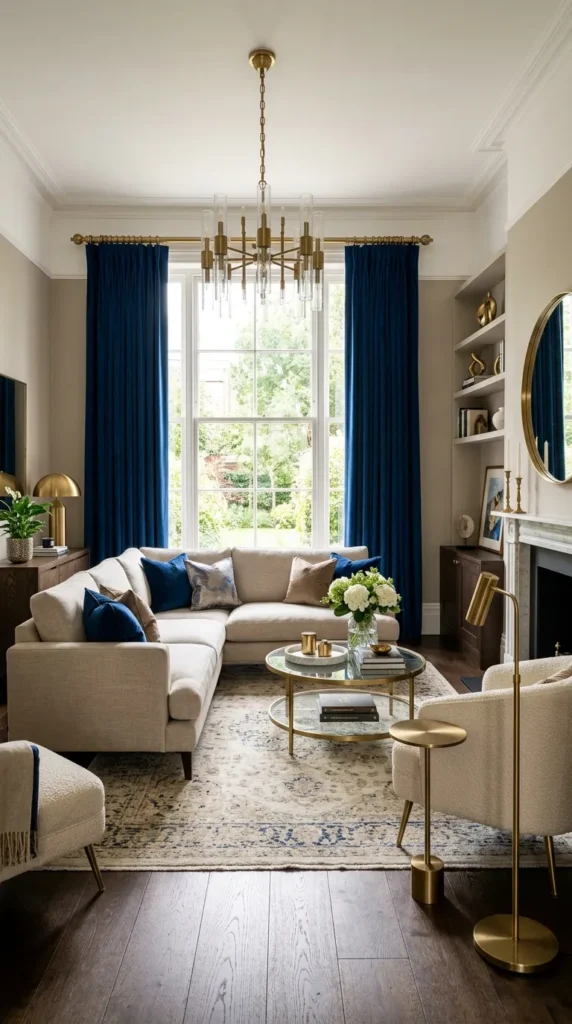
Jewel-toned curtains in deep emerald, rich sapphire, warm ruby, vibrant amethyst, or lustrous teal bring extraordinary color vitality to living rooms and create focal points of genuine drama and confidence. These saturated, gem-inspired colors have a depth and richness that paler tones lack, and when used at the scale of full-length curtains, they transform the entire emotional character of a room. A living room with deep emerald velvet curtains feels immediately different more intimate, more sophisticated, more deliberately designed than the same room with neutral window treatments.
Jewel-toned curtains work particularly well in living rooms with neutral or white walls, where the color intensity of the curtains provides all the chromatic drama the room needs without overwhelming it. They also coordinate beautifully with warm metallic accents brass curtain poles, gold picture frames, bronze lamp bases where the warmth of metal complements the richness of jewel tones magnificently. Choose a curtain color that references other elements in the room a deep green curtain that echoes a botanical print on the wall, or a sapphire curtain that picks up a blue thread in an area rug to create a color story that feels composed and intentional rather than simply bold. Jewel-toned curtains in quality fabrics represent a genuine investment in your room’s atmosphere and character.
9. White and Crisp Curtains for Clean, Timeless Simplicity
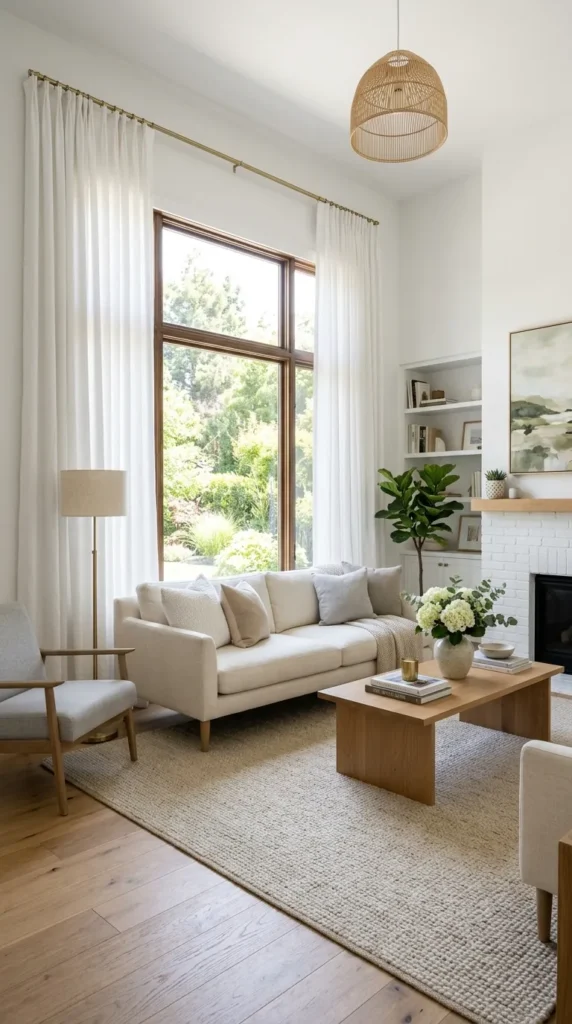
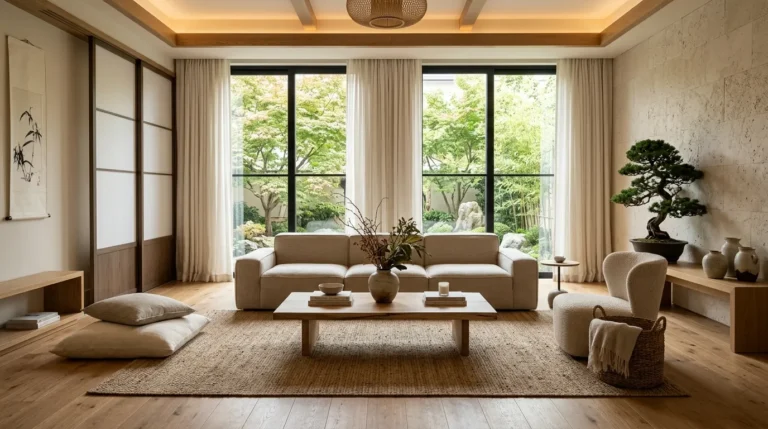
White curtains in a quality, substantial fabric with sufficient weight to hang well create a quality of clean, timeless simplicity that works in virtually every living room aesthetic. White curtains against white or pale walls create a seamless, serene effect where the window treatment almost disappears, allowing the architecture and furniture to take center stage. White curtains against darker walls create a crisp contrast that frames the window as a bright, light-filled feature. White curtains in any context bring light, air, and a sense of clean order to a room that busy patterns or heavy colors can obscure.
The key to white curtains that feel luxurious rather than institutional is fabric quality and fullness. Cheap white fabric has a flat, synthetic quality that reads as utilitarian. Quality white linen, cotton, or silk has a warmth and depth that even white fabric can convey the slight variations in weave, the natural texture of the fiber, the way quality white fabric catches light and holds shadows in its folds. Allow generous fullness at least double the window width in fabric so white curtains gather into substantial, beautiful folds rather than hanging flat. A pure white curtain in insufficient fullness looks like a bedsheet. The same fabric in generous fullness looks like an interior design photograph. This principle of fabric quality and generous fullness applies to every curtain choice but is most visible and most critical with white.
10. Striped Curtains for Graphic, Tailored Elegance
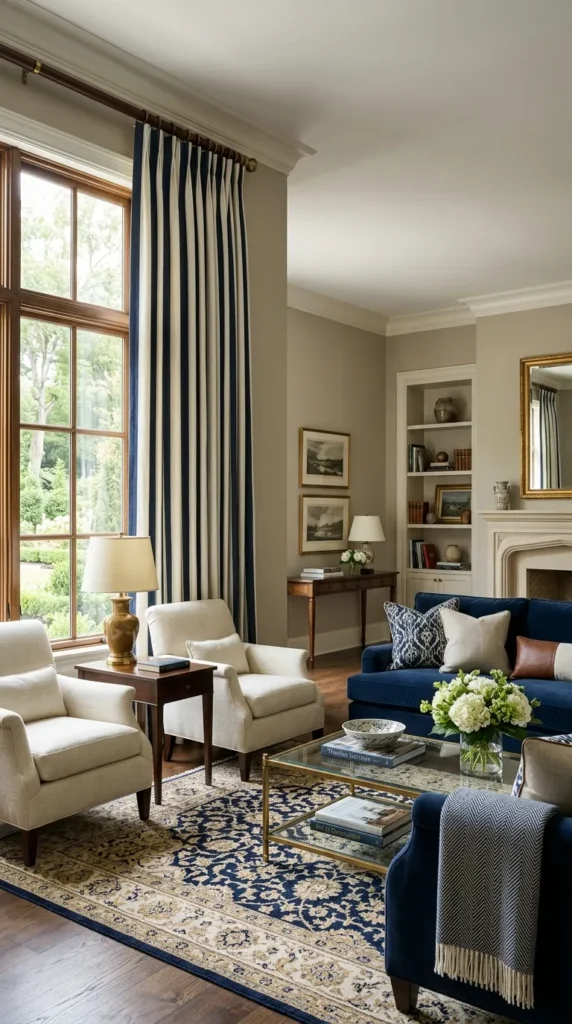
Striped curtains whether wide horizontal stripes in bold contrasting colors, fine vertical pinstripes in tonal shades, or broad vertical stripes in classic combinations bring graphic clarity and tailored elegance to living room windows. Vertical stripes running the full length of floor-to-ceiling curtains emphasize height and create a sense of architectural formality. Horizontal stripes introduce visual width and a more casual, coastal energy. Tonal stripes in similar shades create subtle pattern interest without color drama. Bold contrasting stripes make strong graphic statements.
The most enduring striped curtain combinations are those with genuine design heritage navy and white for coastal and nautical sophistication, black and cream for graphic contemporary elegance, forest green and ivory for a refined natural aesthetic. Striped curtains work particularly well in living rooms with relatively simple furniture and minimal pattern elsewhere, where the stripe provides all the graphic energy the space needs. They also coordinate beautifully with other striped elements in the room a striped area rug, striped cushions in smaller scale when all stripes share a common color story. Choose curtains where the stripe runs perfectly parallel to the curtain’s edges for a crisp, tailored finish that looks professional and intentional.
11. Curtain Poles and Hardware as Design Features
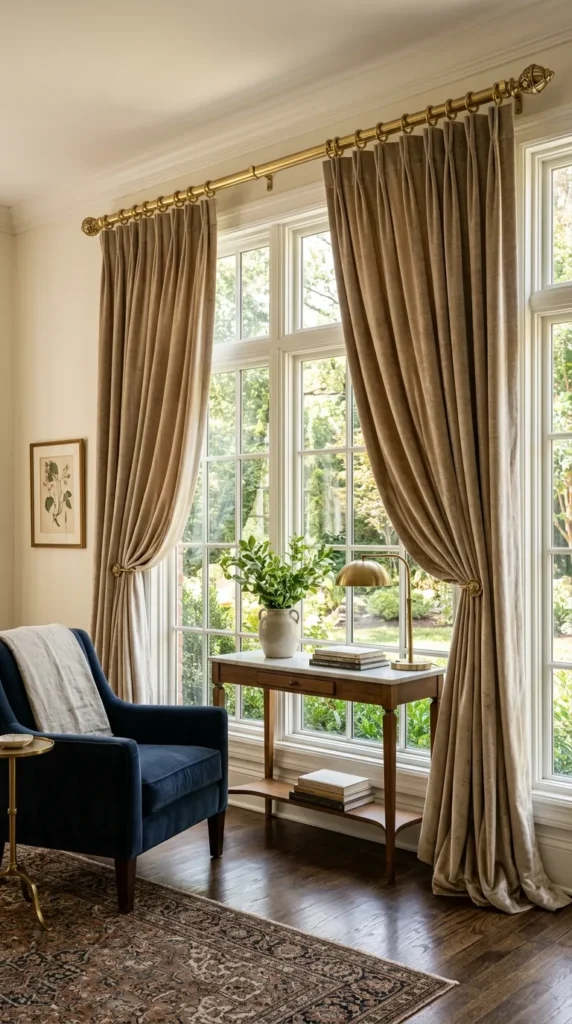
The curtain pole, track, and associated hardware are not merely functional elements for hanging fabric they are visible design components that contribute significantly to the window treatment’s overall visual quality. A beautiful brass curtain pole with decorative finials makes a genuine design statement even before the curtains are drawn. A matte black iron pole with simple cylindrical finials suits industrial and contemporary aesthetics. An antique bronze pole with ornate finals feels traditional and refined. The hardware frames the entire window composition from above and deserves the same design consideration as the fabric.
Curtain poles in warm metals brass, antique gold, burnished bronze coordinate beautifully with living rooms featuring warm metallic accents in lamps, picture frames, and furniture hardware, creating a consistent metallic thread throughout the room. Choose pole diameter in proportion to curtain weight heavy velvet or interlined fabric requires a substantial pole of at least 28mm diameter that will not flex under load. Ensure sufficient brackets are used for the pole’s length a long pole with too few brackets will visibly sag under the weight of heavy fabric, undermining the entire window treatment. Rings should glide smoothly along the pole without catching test this before hanging curtains, as sticky rings that resist opening and closing are frustrating daily irritations.
12. Roman Blinds with Curtain Panels
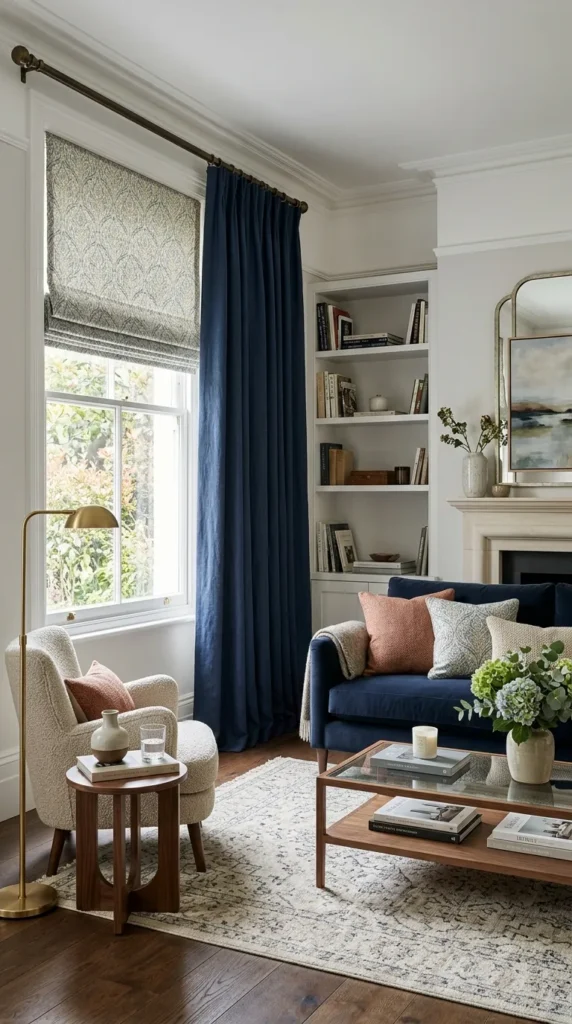
Roman blinds fabric blinds that fold into neat horizontal pleats when raised and lie flat when lowered combined with full-length curtain panels create a window treatment of layered sophistication and excellent practical function. The Roman blind provides clean, architectural light control within the window recess, while the curtain panels frame the window on either side, adding softness, color, and the sense of generous dressing that blinds alone cannot provide. Together, the two elements create a window treatment that feels considered and complete.
The fabric pairing of Roman blind and curtain panels offers considerable design opportunity. A Roman blind in a bold pattern a geometric print, a botanical design, a textured weave paired with simple solid curtain panels in a color pulled from the blind’s palette creates a composition where the blind provides pattern interest and the curtains provide grounding. Conversely, a simple textured or solid Roman blind paired with patterned curtain panels allows the curtains to make the statement while the blind provides clean functional backup. The key is ensuring that blind and curtain fabrics share sufficient visual connection similar tonal family, coordinating pattern scale, or complementary texture to read as an intentional composition rather than two separate decisions made without reference to each other.
13. Curtains with Contrast Leading Edge
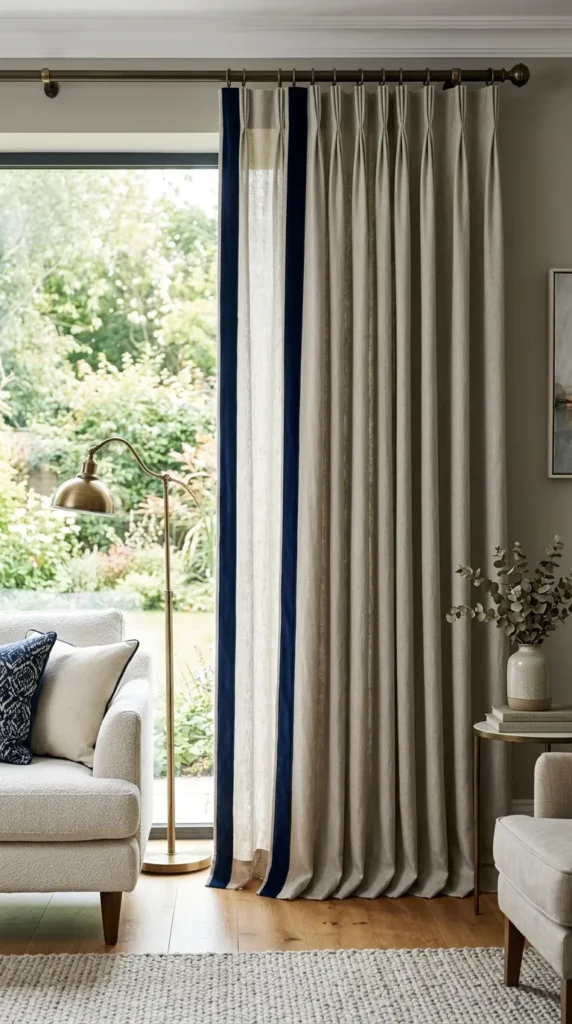
A contrast leading edge a band of different fabric, typically three to six inches wide, running the full height of the curtain’s inner edge is one of the most elegant and underused curtain design details available. This simple technique transforms a plain curtain into something that looks custom and considered, adding a layer of visual interest and design intentionality that mass-produced curtains never have. When the contrast edge is in a color or pattern that references other elements in the room, it creates a subtle but sophisticated visual connection that speaks of genuine design thought.
The contrast leading edge works beautifully in several combinations. A plain linen curtain with a narrow velvet contrast edge in a jewel tone adds a line of color richness that elevates the entire panel. A patterned curtain with a contrast edge in one of the pattern’s dominant solid colors creates a framing effect that emphasizes the pattern and adds tailored definition. A neutral curtain with a contrast edge in a bold geometric print adds pattern interest at the curtain’s most visible edge. The contrast edge detail is best made by a skilled curtain maker who can ensure the edge is perfectly straight and the seam between main fabric and contrast is immaculately executed a poorly made contrast edge looks worse than none at all, while a beautifully made one is a detail that genuinely distinguishes a custom curtain from an off-the-shelf one.
14. Curtains That Coordinate with Wallpaper
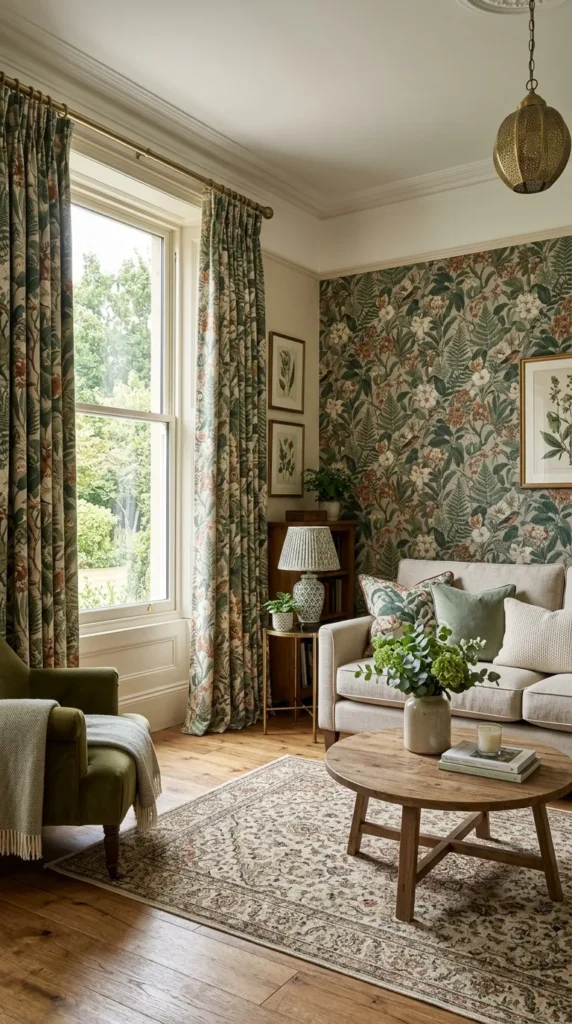
When a living room features a wallpapered accent wall or fully papered room, curtains that coordinate with the wallpaper sharing colors, referencing the pattern, or using a fabric that is explicitly designed to match a specific wallpaper create a window treatment of exceptional visual cohesion and design intentionality. Many wallpaper designers produce matching or coordinating fabric specifically for curtains, allowing walls and windows to speak the same design language with variations of scale and material that keep the combination interesting rather than monotonous.
The most successful wallpaper and curtain combinations are those where the two elements share color but differ in pattern scale or treatment. A large-scale botanical wallpaper paired with curtains in a small-scale version of the same botanical print creates visual harmony with sufficient variation to avoid looking like a hotel lobby. A geometric wallpaper paired with curtains in a solid tone from the wallpaper’s palette allows the wall pattern to remain the focal point while the curtains extend its color story to the windows. A maximalist floral wallpaper paired with curtains in a plain fabric that precisely matches the floral’s background color creates a sophisticated effect where the curtains become an extension of the wall when drawn. Whatever combination you choose, ensure the transition between wallpaper and curtain fabric is considered and intentional the point where wall pattern and curtain fabric meet at the window frame is a visible seam that deserves careful design thought.
15. Tab Top and Eyelet Curtains for Casual Modernity
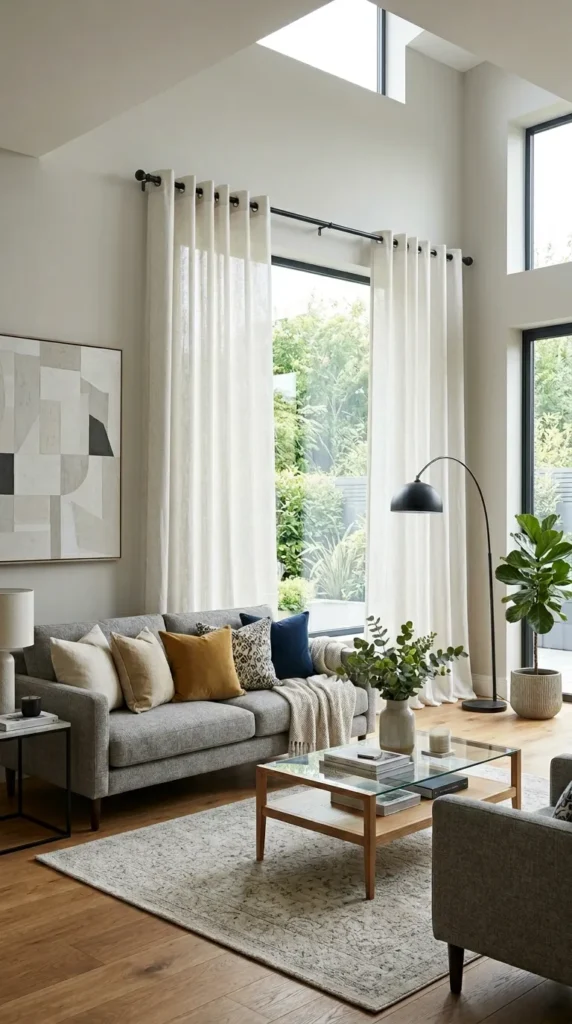
Tab top curtains those with fabric loops sewn directly onto the top of the panel that thread onto the curtain pole and eyelet curtains those with metal-ringed holes punched through the fabric heading through which the pole passes directly both create a casual, contemporary curtain heading that suits relaxed, modern living rooms. Unlike formal pleated headings that require pencil pleat tape or pinch pleat construction, tab tops and eyelets have a clean, unfussy quality that feels appropriately relaxed for casual living spaces.
Eyelet curtains create evenly spaced, regular folds when drawn back, with the pole visible through the rings above the hardware becomes part of the design rather than being concealed by the heading. This works beautifully with decorative poles in brass, matte black, or brushed nickel where the pole itself is worth seeing. Tab tops have a slightly more casual, artisan quality the fabric loops have a handmade feel that suits natural fabrics like linen and cotton particularly well. Both headings require the curtain fabric to be hung directly on the pole rather than on rings, which limits the ease of drawing curtains on wider windows. For poles over about 180cm wide, rings with clips or a track system will be more practical for daily use.
16. Blackout Curtains That Do Not Sacrifice Style
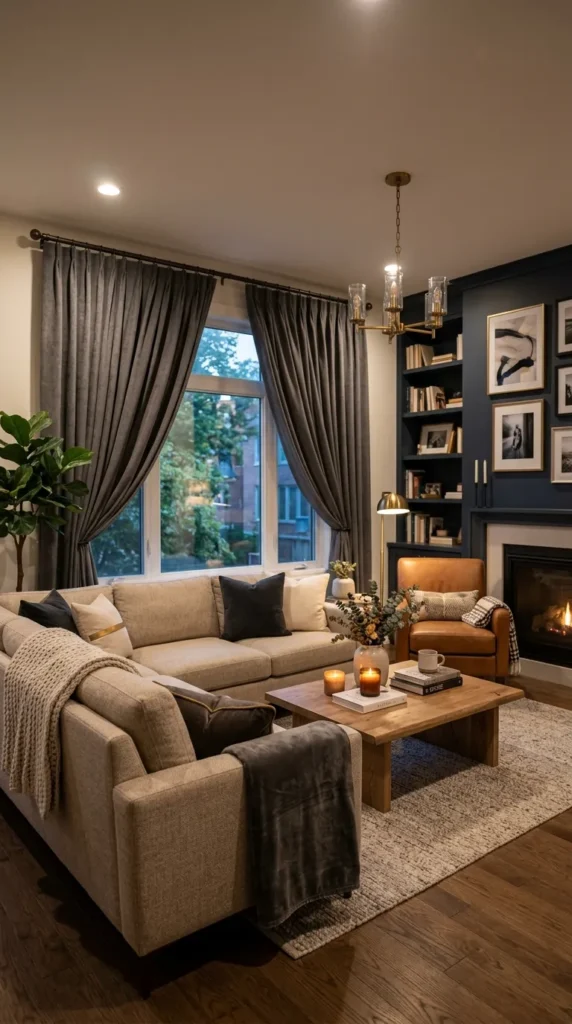
Blackout curtains those with a light-blocking lining that prevents any light from penetrating the fabric are essential in living rooms used frequently for television viewing, daytime napping, or in locations with significant street lighting. The challenge has historically been that blackout linings add bulk and stiffness to curtain fabric, compromising the beautiful drape that makes curtains so visually appealing. Contemporary blackout lining technology has improved dramatically, however, and it is now possible to achieve complete light blocking without significantly affecting fabric drape.
The most effective approach for blackout curtains that remain beautiful is choosing a fabric that hangs well even with additional lining weight heavy linen, velvet, or thick cotton all maintain their drape with blackout lining better than lighter fabrics. Alternatively, a separate blackout roller blind fitted within the window recess provides complete light blocking independently from the curtain, allowing you to choose any curtain fabric purely on aesthetic grounds without compromise. This layered approach blackout blind plus beautiful curtains is the solution used in the finest hotels precisely because it allows each element to be optimized for its specific function: the blind for light control, the curtains for beauty and atmosphere.
17. Curtains with Pelmets and Valances for Formal Elegance
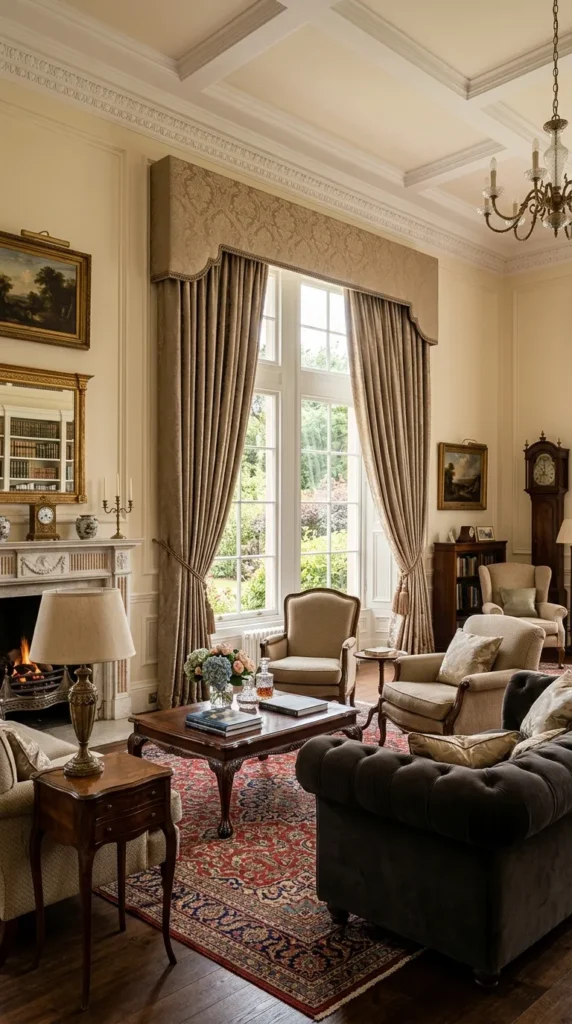
A pelmet a rigid board, typically fabric-covered or painted, fixed above the window to conceal the curtain track or pole or a valance a soft, gathered or pleated fabric header fixed above the curtains adds a layer of formal, traditional elegance to living room windows that suits period homes and traditionally decorated spaces. The pelmet or valance conceals the mechanical elements of the curtain hanging system, creating a cleaner, more finished appearance at the top of the window treatment and adding height and architectural weight to the composition.
Pelmets can be shaped with curved or pointed lower edges that add decorative detail or straight-edged for a cleaner, more contemporary version of the traditional treatment. They are typically upholstered in the same fabric as the curtains or in a coordinating fabric, and can be trimmed with braid, fringe, or contrast piping for additional decorative detail. Valances in gathered or pleated fabric add a softer, more romantic quality than rigid pelmets. Both treatments add visual height to windows when fixed above the window frame and serve the practical purpose of concealing tracks and poles that may not be attractive enough to feature. In period homes with original architraves and cornicing, a well-designed pelmet integrates the window treatment into the room’s architectural language in a way that exposed poles and tracks never quite achieve.
18. Sustainable and Natural Fabric Curtains
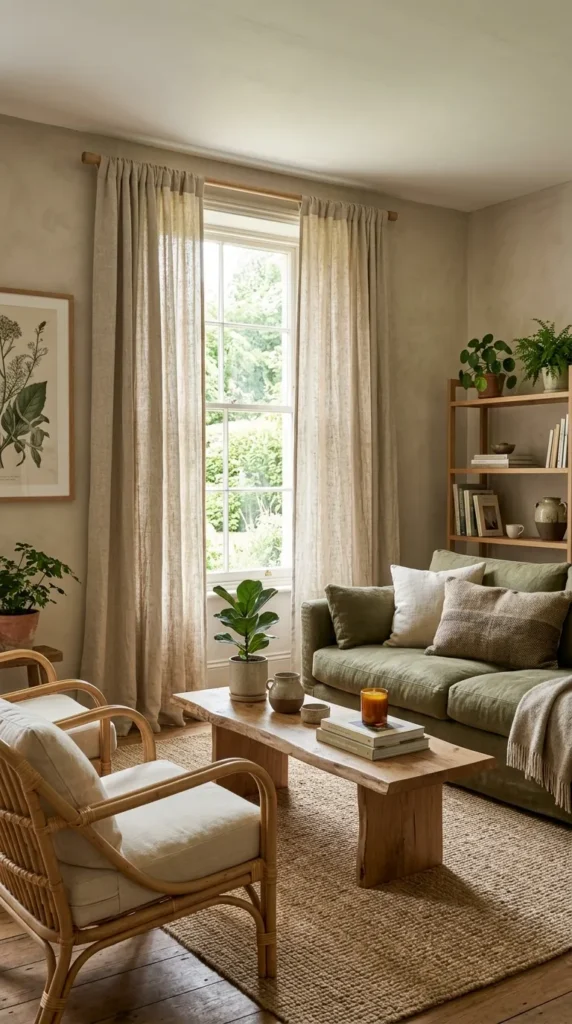
Growing awareness of the environmental impact of interior design has led to a significant increase in beautiful, sustainable curtain fabric options that prioritize natural fibers, responsible production, and longevity over fast fashion interior trends. Organic linen, organic cotton, hemp fabric, and undyed natural fibers produced with minimal environmental impact are now available from specialist sustainable textile producers in qualities that rival conventional alternatives. Choosing curtains in these materials is both an environmental and an aesthetic statement natural, undyed, or naturally dyed fabrics have a depth of tone and material integrity that synthetic or chemically processed alternatives consistently lack.
Recycled fabric curtains made from recycled plastic bottles, post-consumer textile waste, or deadstock fabric that would otherwise be discarded have also improved enormously in quality and range. Some of the most beautiful contemporary curtain fabrics are made entirely from recycled materials, with textures and drape that bear no resemblance to early iterations of recycled textiles. Investing in sustainable curtain fabrics also encourages longer-term thinking about window treatments choosing fabric you genuinely love in a material that will last decades, made by producers whose practices you can support with confidence, creates curtains that represent genuine value in every sense of the word.
Choosing the Right Curtains for Your Living Room
The right curtains for your living room are those that work beautifully at every time of day, in every season, and with every aspect of your room’s design fabric, color, pattern, heading style, length, and hardware all working together as a unified composition rather than a collection of separate decisions. Begin with your room’s natural light a north-facing room that receives little direct sun benefits from warm, light-reflective fabrics in pale tones; a south-facing room that receives strong direct light can carry heavier, darker fabrics without the room feeling oppressive.Consider your curtains in relation to everything else in the room simultaneously fabric, color, pattern, heading style, length, and hardware all affect each other. A bold patterned curtain needs simple furniture; a simple curtain can carry more pattern in the room around it. A heavy velvet curtain needs a substantial pole and generous heading height; a light linen sheer can hang from a simple track without elaborate hardware. Invest in quality fabric and professional making curtains that are beautifully made in quality fabric will outlast trends, wear, and changing fashions for decades, while cheap alternatives will look tired within a few years. Your living room windows are among the most visible surfaces in your home. Treat them with the design seriousness they deserve and the reward is a room that feels genuinely finished, genuinely personal, and genuinely beautiful in every light.